ESG and Sustainability in 2026: Why eAsia Committed for Green Future Is More Than a Tagline
ESG has quietly moved from a CSR footnote to a boardroom priority — and a career expectation. Here's why eAsia committed for green future isn't a slogan, and how it can fast-track your ESG career.
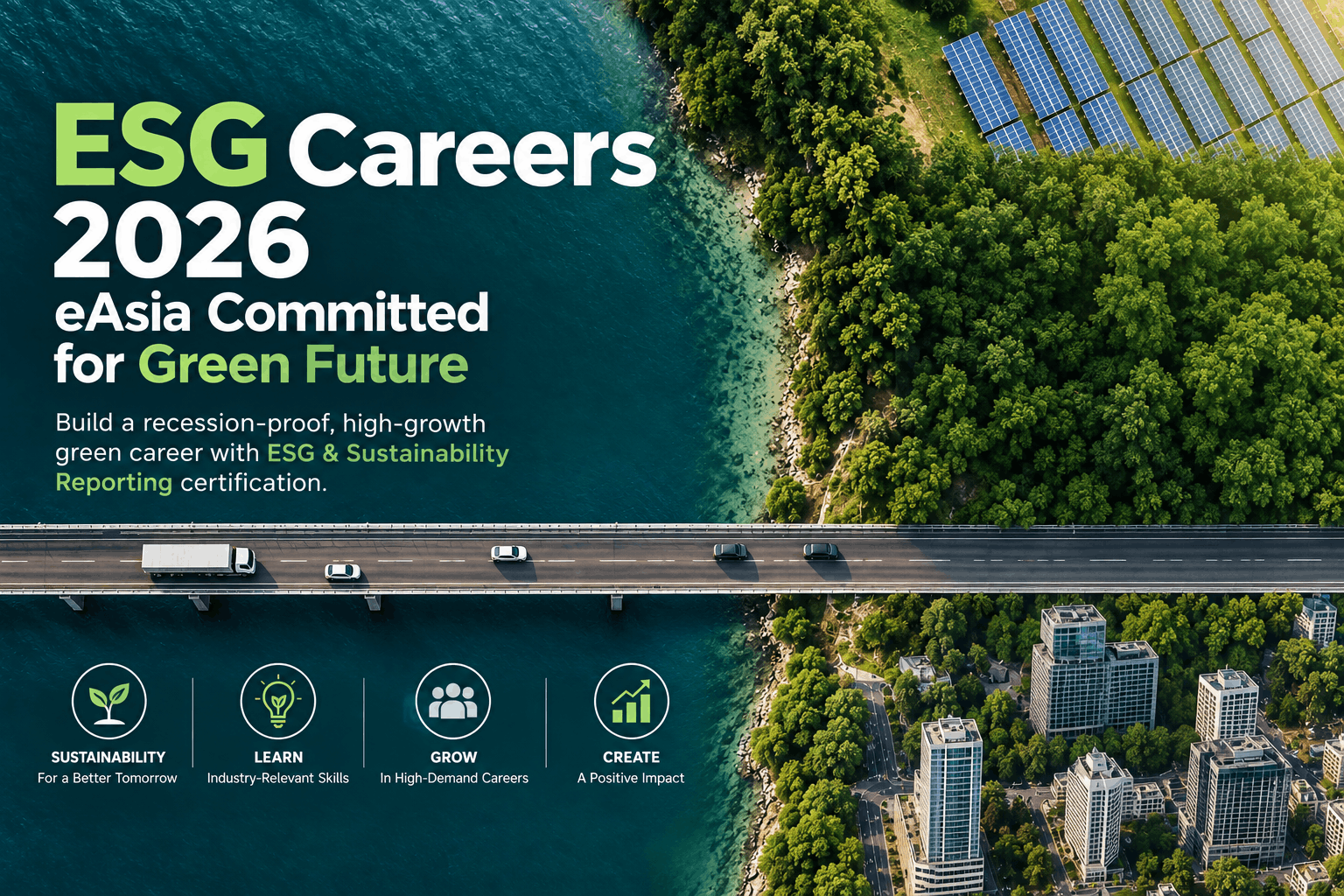
ESG reporting has become mandatory for the boardroom
Certification surpasses fragmented self-learning
Net-zero drive in India is generating jobs
eAsia is dedicated to sustainable future
It's 9:47 PM and Meenal is still working at her desk. Not that she has been asked by her boss to stay back, but after an hour of reading through the new BRSR disclosure obligations that her company had put out and not knowing what half the words meant, she figured she might as well try to catch up a bit. She is a finance manager with six years of experience under her belt.
If any of this seems familiar to you, you’re not alone. In India, human resource chiefs, compliance officers, financial managers, even marketers are finding themselves dragged into discussions on carbon reporting, sustainability auditing, and stakeholder reporting – all without any formal training. The business world is no longer asking for anything. They expect it.
It's precisely this reason that makes eAsia committed to a green future, not just a marketing buzzword, but the bedrock on which eAsia builds its educational programs for ESG and sustainability. In this article, we look at what makes this commitment so important in 2026.
01The silent revolution: ESG reporting is no longer an option
"Sustainability" was just one aspect of the CSR section in the annual report five years ago. It is no more. BRSR, a directive issued by the SEBI for businesses in India, now covers the top 1,000 listed firms, and the number is set to go up further. International frameworks like GRI and TCFD have become the bare minimum requirement for any company aspiring to secure investments from responsible investors.
So what does this translate to in practical terms? It translates to every functional area – not just the Sustainability department – being required to know about ESG. For procurement teams, it means checking the environmental compliance of the supplier. It means for HR teams tracking social indicators such as diversity and labour standards. It means for finance teams disclosing according to the needs of the investors.
02Why "dedicated" is the right word
There are many institutes out there providing a hasty and generalized ESG certificate assembled from old Power Points. Not eAsia. The commitment to be green in future means that the syllabus will change according to the regulatory changes, examples of modules will come from Indian industry disclosure and all modules will have one purpose, which is to make you ready for jobs.
"A course built once and left untouched for three years is teaching history, not a skill — that's the opposite of being committed for green future."
03Conventional roles vs. ESG-certified professionals
The market is already separating professionals who "know some sustainability basics" from those who hold a recognized, structured ESG certification. Here's how the two compare:
| Parameter | Traditional / Self-Taught Approach | ESG-Certified Professional (eAsia) |
|---|---|---|
| Knowledge base | Fragmented, based on articles and webinars | Structured curriculum covering GRI, BRSR, TCFD, and net-zero pathways |
| Practical application | Limited hands-on reporting experience | Real case studies and capstone project based on live industry disclosures |
| Industry recognition | Not formally validated | IIT Roorkee-backed professional certification |
| Career mobility | Slow, dependent on internal opportunities | Direct pathway to ESG Analyst, Sustainability Manager, CSR Lead roles |
| Salary leverage | Minimal negotiating power | Certification strengthens appraisal and job-switch conversations |
The gap isn't about intelligence or effort — professionals like Meenal are plenty capable. The gap is about structured, credible learning that a scattered pile of YouTube videos simply can't replace.
Ready to Close That Gap?
Join the Professional Certificate Program in ESG & Sustainability Reporting — built with IIT Roorkee, designed for working professionals.
045 reasons your career requires ESG certification
Not sure if this is the right moment for you? Here are the signals we hear most often from professionals right before they enroll:
New Sustainability Committee
Your company just formed one — someone will lead it internally, why not you.
Unfamiliar ESG Terms
Scope 1, materiality, greenwashing risk — nodding along isn't the same as understanding.
Future-Proofing Your Role
Compliance, finance and ops roles now expect sustainability literacy.
Eyeing a Career Pivot
ESG is one of India's fastest-emerging, least saturated career tracks.
And the fifth sign? You believe in the mission, not just the paycheck. Plenty of professionals are drawn to ESG because it aligns work with purpose — that authenticity, backed by real skills, is what makes for the strongest long-term careers.
05How is eAsia's ESG program unique?
This program isn't built by marketers guessing what sounds impressive — it's built around what Indian companies are actually asking for in ESG hires. That includes:
India-Specific Frameworks
BRSR, SEBI disclosure norms, and sector-specific sustainability benchmarks.
Global Standards
GRI, TCFD, and carbon accounting principles used by multinational reporting teams.
IIT Roorkee Academic Backing
Lending credibility that stands out on a resume.
Capstone Project
Based on a real disclosure scenario, so you leave with a portfolio piece, not just a certificate.
This is the practical form that "eAsia committed for green future" takes — not abstract idealism, but a curriculum engineered around employability.
06India needs your expertise in its green economy
India has committed to net-zero emissions by 2070, and the intermediate targets are aggressive. That translates into massive hiring demand across renewable energy, ESG advisory, carbon markets, and sustainability consulting over the next decade. Professionals who position themselves early — with credible certification — stand to benefit the most from this shift.
Meenal, from our opening story, eventually did enroll in a structured ESG program. Within four months, she wasn't just keeping up with BRSR requirements — she was leading her company's sustainability reporting taskforce. That's the kind of shift a real certification can create.
Your Green Career Starts Here
Don't let ESG become someone else's opportunity. Enroll in eAsia Academy's ESG & Sustainability Reporting Certificate today.
07The Three Programs That Define eAsia Academy
Professional Certificate Program in ESG & Sustainability Reporting — build and interpret real ESG disclosures using GRI, SASB, TCFD, and BRSR, with a live capstone project and IIT Roorkee-backed certification.
Also exploring adjacent green and people-analytics careers? eAsia Academy's Carbon Credits & Net-Zero Pathways and HR Management & Analytics Using AI programs follow the same practitioner-led, project-based model.
FAQs
It means that the course content, faculty and partnership with IIT Roorkee have been designed keeping in mind the requirements of professionals in India’s transition to sustainable and net-zero businesses.
Working professionals in Finance, HR, Operations, Compliance, Management, as well as fresh graduates who want to carve a niche for themselves in the field of green careers.
No. This course begins from the basics of ESG and covers advanced levels, such as BRSR, GRI and TCFD.
It is a flexible and cohort based course program that includes live classes, case studies and projects, resulting into certification from IIT Roorkee.
ESG Analyst, Sustainability Reporting Manager, CSR Lead, Net-Zero Strategy Consultant, Sustainability Compliance Officer, etc.