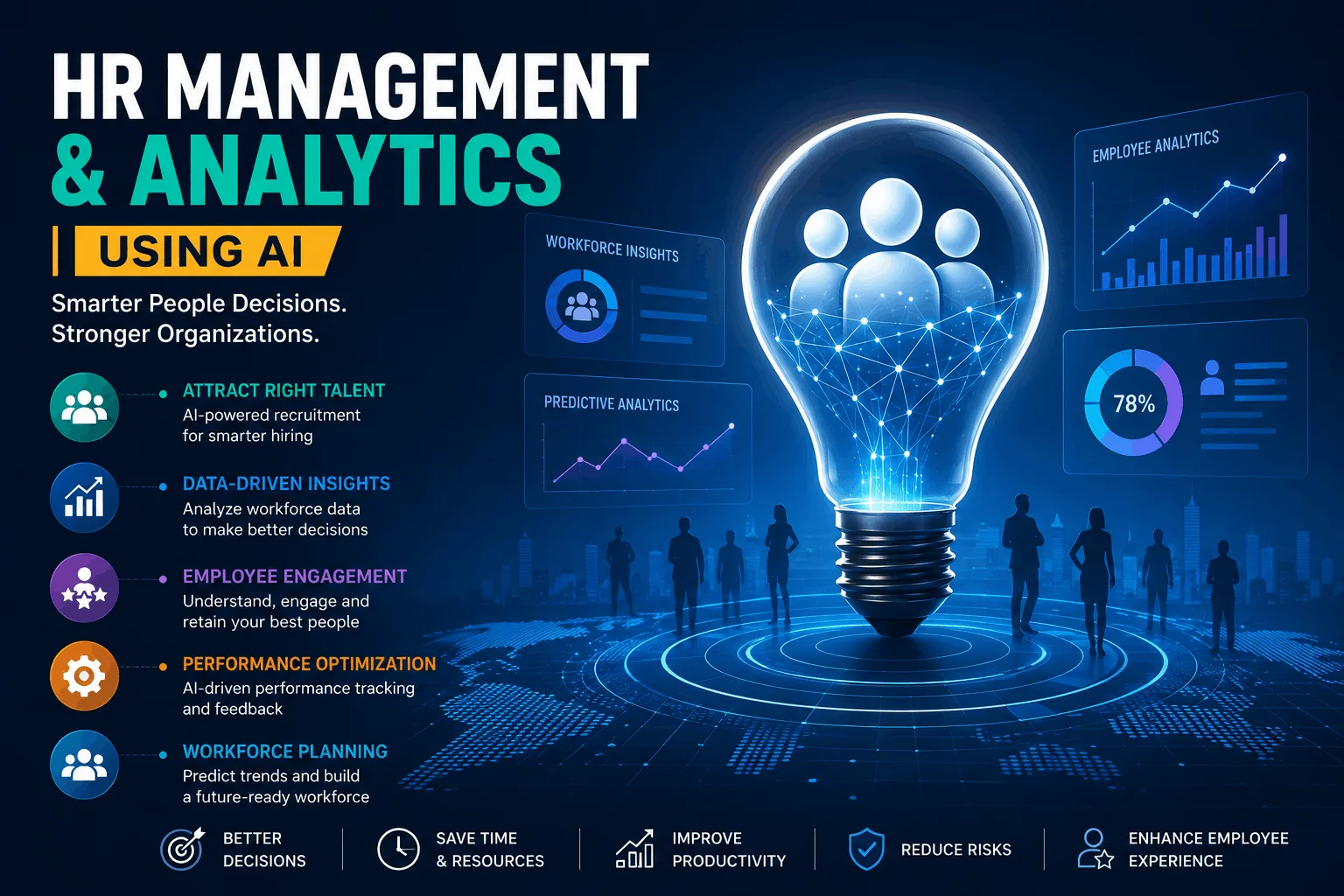
Human Resource Management & Analytics Using AI: Benefits, Skills and Career Opportunities
AI technology has brought about changes in how organizations handle their workforce, decision making, and future human resource requirements. Human Resource Management is not just restricted to areas like recruitment, payroll, engaging the workforce, and administration anymore. The combination of HR analytics and AI helps in taking quick and informed decisions.
For the benefit of students, HR professionals, managers, and other working professionals, studying Human Resource Management and Analytics Using AI may prove to be very useful.
What Is Human Resource Management using AI?
Human Resource Management using AI is the use of artificial intelligence to carry out various HR functions. The technology will help companies make analysis of massive amounts of workforce data and automate processes.
AI can be employed in recruitment, employee engagement, performance management, workforce planning, training and development, and talent management.
But the role of HR specialists cannot be underestimated by AI technologies. They may help HRs to save time from repetitive tasks and concentrate on strategy and relationships within the company.
What Is HR Analytics?
HR analytics or People Analytics is the process of using employee or workforce data to help understand trends that can facilitate better business decisions.
For instance, the HR team can perform analytics on information about the attrition rate, recruiting effectiveness, absenteeism, cost of workforce, engagement, and performance.
The combination of AI with HR analytics enables the identification of patterns and generation of insights.
Advantages of AI in Human Resource Management
1. Quick Recruitment
The process of recruitment includes evaluating many applications, organizing interviews, communicating with applicants, and analyzing recruitment information.
AI software can help HR managers in conducting applicant screening, making job descriptions, communicating, and analyzing recruitments.
In this way, it helps HR specialists to spend less time on the process and to concentrate on evaluation of the candidates.
2. Employee Analysis
There is much information generated by HR departments.
Without proper tools, it is hard to transform information into useful knowledge.
With the help of AI and analytics, specialists can analyze trends in the workforce, compare some relevant metrics, and see the pattern of the process like employee turnover and recruiting.
3. Enhanced Employee Experience
Moreover, AI can contribute to enhanced employee experience by providing fast access to information and automated HR interactions.
For instance, AI-based HR assistants can provide assistance to employees regarding their concerns about HR information, company policies, etc.
This will make things easier for both parties, and HR will be able to concentrate on other employee needs.
4. Performance Management Based on Data
Performance management is sometimes quite subjective.
HR analytics can be used by an organization to review performance-related information. AI can be used for analyzing data and obtaining insights which will be used by HR professionals during performance talks.
Human intervention still plays a significant role in the process, especially in making decisions which concern employees.
Important Skills for AI and HR Analytics Professionals
Individuals who want to be involved in this discipline are expected to possess a combination of knowledge about HR, data analysis skills, and understanding of technologies.
Important skills are:
Human Resources Management: Knowledge of recruitment, relations with employees, performance management, talent management, compensation and organizational development.
Data Analysis: Learning how to make sense out of HR data and analyze trends.
AI Literacy: Understanding how AI works, what it can do, its limitations and possible applications in HR.
Communication: HR specialists have to communicate their data-based insights to managers, employees, and company stakeholders.
Critical thinking: Data may support decision-making process, but HR specialists have to assess whether these insights are reliable, relevant and appropriate.
Data Privacy and Ethics: HR specialists have to be aware of responsible data usage and its privacy and ethics issues.
Opportunities in AI-Enabled HR
The integration of HR, analytics, and AI may offer chances for different positions.
Some examples of career paths may include HR Analytics Specialist, People Analytics Analyst, HR Business Partner, Talent Analytics Specialist, HR Technology Specialist, Workforce Planning Analyst, Talent Acquisition Specialist, and HR Consultant.
Responsibilities and requirements for the jobs differ depending on the company and position.
Those who have prior HR experience may learn about analytics and AI to increase their skillset. The same can be done vice versa – people with an analytics or tech background may study HR to switch to people-oriented professions.
How to Prepare for a Career in AI and HR Analytics
The first step is to understand the fundamentals of Human Resource Management. Once you have a strong HR foundation, develop knowledge of HR analytics, workforce metrics, data interpretation, and AI applications.
Practical learning is also important. Try working with sample HR datasets, creating workforce dashboards, analyzing employee turnover, or exploring how AI tools can support HR processes.
A structured Human Resource Management and Analytics Using AI course can also help learners develop knowledge in a systematic way.
When selecting a course, look at the curriculum, practical learning opportunities, faculty, certification, duration, and relevance to your career objectives.
Future of AI in HR
AI will probably become more entwined with HR practices. Employers might adopt AI and analytics to enhance workforce planning and forecasting, recognize their talent needs, automate administrative tasks, and develop business insights.
On the other hand, human skills such as empathy, communication, leadership, judgment, and relationship building will remain important for successful HR practitioners.
Thus, the future of HR does not only depend on technology but also on combining human expertise and data analytics.
Build Future-Ready HR Skills With eAsia Academy
Human Resource Management is evolving, and professionals who understand both people and technology can be better prepared for the changing workplace.
Learning HR management, analytics, and AI can help professionals understand how technology can support recruitment, workforce planning, employee management, and strategic HR decision-making.
If you are looking to upgrade your HR skills or explore new career opportunities, a structured professional learning program can be a valuable step toward developing future-ready capabilities.
Explore relevant professional learning opportunities at eAsia Academy and choose a program aligned with your career goals.
FAQs
It refers to the process through which HR data is analyzed to come up with trends and insights in order to make HRM decisions.
AI can help with recruitment, communication within employees, HR analytics, talent management, performance analysis and many other HR functions.
Artificial intelligence can take over some tasks that are done over and over again. Human resource professionals are still needed for making important decisions, building relationships with employees, providing leadership, communicating effectively and using good judgment when it comes to ethics.
Important skills include knowledge of human resources, the ability to analyze data, understanding of artificial intelligence, the ability to think critically, good communication skills and awareness of data privacy and ethics.
Human resource analytics can be a career option for people who want to mix human resource management with data and technology.