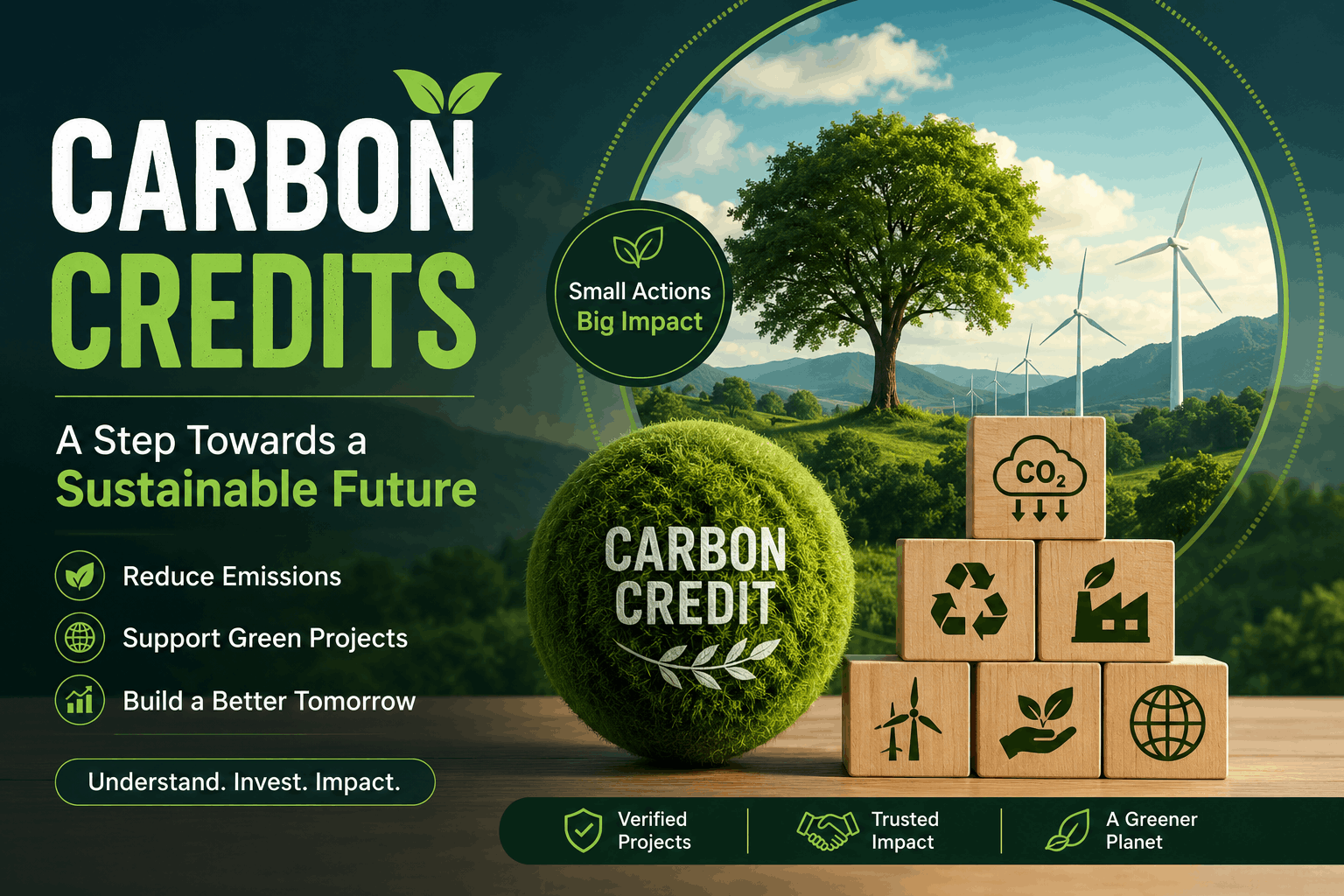
Carbon Credits: Meaning, How They Work & Benefits | Complete Guide
Everything You Need to Know about Carbon Credits
Climate change having taken on one of the most serious global problems that people are trying to solve. That is why countries governments, businesses, and private people are looking for ways to reduce greenhouse gas emissions. An important solution that providing a chance for solving the problem is carbon credits.
But what are carbon credits and how do they work?
Generally, a carbon credit can be described as a tradeable certificate or instrument that shows the reduction, removal, or avoidance of one metric tonne of carbon dioxide equivalent (CO₂e) according to the regulations of a particular carbon market or project.
The carbon credits allow motivating projects and companies to reduce greenhouse gases emissions is an important part of the transition towards a low-carbon economy and achieving global net-zero objectives. This article will analyze the meaning of carbon credits, the principles of carbon credit work, their advantages, types of carbon credits, carbon credits market, and prospects of carbon credits in India.
What Is a Carbon Credit?
In simple terms, a carbon credit means a certified amount of greenhouse gases that has either been eliminated, decreased, or avoided in the environment.
For example, carbon credits can be generated by:
- The installation of renewable energy systems
- The implementation of wind or solar energy projects
- The enhancement of energy efficiency
- The capture of methane emissions
- The promotion of certain forestry or ecosystem restoration projects
- The employment of cleaner technologies
- The waste management and decrease of landfill emissions
Once the approved procedures and methodology are implemented, the eligible emissions reductions or removals may be issued carbon credits, which can then be traded, bought, or retired according to the particular carbon market rules.
How Does Carbon Credit Program Work?
Knowing the mechanism behind carbon credits is useful for anyone interested in sustainability, ESG, climate finance, or carbon markets.
While there are specificities of different programs and markets, the basic process is given below.
1. Development of a Carbon Reduction Project
The project is created to reduce, avoid, or eliminate greenhouse gas emissions.
For instance, the implementation of a renewable energy project might help produce energy, which would otherwise have been created through fossil fuel use. Also, projecting energy efficiency might reduce energy consumption involved in a certain task.
2. Measurements of Emission Reductions
The project computes its possible emission reductions through an accepted methodology. This methodology usually takes into consideration issues such as baseline emissions, project emissions, monitoring needs, and other relevant parameters.
3. Validation and Verification
Depending on the programme, independent accredited bodies may review the project activities and the emission reductions. The process may include validation, monitoring, verification, and specific programme requirements.
This step contributes to ensuring that the carbon credits are associated with real and quantifiable climate benefits.
4. Issuance of Carbon Credits
Upon compliance with program specifications, qualifying emission reductions or removals may lead to carbon credits issuance.
In some systems, a single carbon credit equates to one metric tonne of CO₂.
5. Trading or Retirement of Carbon Credits
Carbon credits may be bought by companies from relevant marketplaces or project developers.
Credits can be retired by companies as part of their climate strategy or while supporting a specific emissions-related claim, subject to requirement of standards, rules, and disclosures.
Categories of Carbon Credits
There exists a number of categories and frameworks within the carbon market. Familiarizing oneself with these is crucial prior to engaging in the carbon credit market.
1. Compliance Carbon Credits
Compliance markets arise as a consequence of government and regulatory frameworks. Companies or sectors governed by these frameworks may face the risk of penalties if they fail to meet their legal requirements regarding emissions.
Market players may have to follow certain guidelines for compliance, using permitted methods as they do so.
2. Voluntary Carbon Credits
The voluntary carbon market allows organizations to voluntarily acquire and retire eligible carbon credits as part of their larger climate or sustainability plans.
Companies may participate in such market with the intention of funding projects aimed at reducing or eliminating greenhouse gas emissions in fulfilment of their climate obligations.
Nevertheless, companies should give due attention to the measures of carbon credits quality, project methodology, verification, additionality, and permanence whenever applicable, as well as the existing guidelines around environmental claims.
Carbon Credits Against Carbon Offsets - Differences
Carbon credits and carbon offsets are often used synonymously, but there are instances where both have a slightly different meaning depending on the usage.
A carbon credit is usually defined as an inter-tradable unit equivalent to a given amount of verified or certified greenhouse gas emissions compensation or abatement.
In contrast, a carbon offset is generally the action of offsetting emissions by funding initiatives that reduce, prevent or remove emissions elsewhere.
As for the practical context, a company might buy and cancel carbon credits to execute an offsetting strategy, although terminology and definitions can vary across different standards, programs, and regulations.
Advantages of Carbon Credits
Carbon credits can be advantageous from the environmental, economic, and strategic viewpoints.
1. Aids Climate Action
Different carbon credit projects can promote various actions against climate change and greenhouse gas emissions.
2. Provides Financial Incentives
The money earned by carbon credits can be helpful for supporting the economic feasibility of specific climate projects; thus, revenues will increase.
3. Promotes Usage of Renewable Energy
Carbon trading can promote investments into cleaner technologies, and renewable energy projects depending on the methodologies in use.
4. Promotes Sustainable Business Practices
Corporations may use good-quality carbon credits as one of the tools in their larger climate strategy in the following step after measuring and decreasing their own greenhouse gas emissions.
5. Generates New Jobs
Increased attention to sustainability and climate issues results in job generation in the areas of:
- Carbon accounting
- ESG reporting
- Sustainability consultancy
- Carbon project development
- Carbon market analysis
- Climate finance
- Environmental management
- Net-zero strategy
Thus, knowledge of carbon credits becomes essential for saving for students and professionals.
What Is Responsible for the Growth of the Carbon Credits Market?
The global interest in cutting down green gas emissions implies more demand for climate-friendly products.
Several reasons lead to the rapid expansion of the carbon credits market. These include:
- Rise in corporate net-zero commitments
- Increased interest in social responsibility
- Government policies regarding climate change
- Investments into renewable energy
- Increased interest in carbon accounting
- Establishment of carbon market systems
- Demand for reliable means of carbon neutralization
- Investors paying greater attention to climate change-related risks
Nonetheless, the carbon market growth also signals the need for more transparency, effective methodologies, reliable verification, and environmental claims of high quality.
Carbon Credits in India
Carbon credits in India is an evolving sector as the country pivots towards a focus on energy transition, sustainability, climate action, and market-based instruments.
India has abundant scope for development in several fields including renewable energy, energy efficiency, waste management, methane mitigation, sustainable practices, and other climate projects.
The establishment of a carbon market framework in India shall open up several avenues of learning for organisations and professionals in:
- Carbon accounting
- Greenhouse gas emissions
- Carbon credit methodology
- Carbon project implementation
- Monitoring and reporting techniques
- Verification methods
- Environment, Social and Governance (ESG) activities
- Carbon trading
- Climate policies
- Net-zero plans
As the sector continues to evolve, it is essential for professionals to stay updated with the latest developments in terms of regulations and standards.
How Businesses can Benefit from Carbon Credits?
Firstly, companies need to realize and analyze their greenhouse gas emissions.
An effective climate change strategy usually takes a comprehensive approach:
- Calculate emissions
- Identify the main sources of emissions
- Reduce emissions if possible
- Set achievable climate goals
- Increase energy efficiency and improve operations
- Use renewable energy sources and low-carbon alternatives wherever possible
- Think about purchasing high-quality carbon credits to offset emissions
- Track and report progress on the actions taken
The future of carbon credits will largely depend on an emphasis on faith, quality, openness, and an honest climate influence. Factors that will contribute to the emergence of carbon credits are:
- Enhanced carbon accounting
- More effective monitoring of projects
- The use of satellite technologies and digital technologies
- Improved verification processes
- Enhanced transparency
- Development of better quality standards
- Carbon dioxide removal technologies
- Climate solutions based on natural elements
- Constantly changing legislation in the area of carbon market trade
- Growing need for experts in the area of sustainability
Learn More About Carbon Credits and Carbon Markets
Knowledge about climate change, greenhouse gas emissions, carbon footprinting, sustainability, ESG, carbon markets, and strategies for achieving the net zero target is needed in order to fully comprehend carbon credits.
It is very important for students, professionals, sustainability experts, and someone running a business to study carbon credits in order to succeed in their activities in the rapidly changing green economy.
At eAsia Academy, learners will be able to avail themselves of educational activities and improve their knowledge about carbon markets among other spheres.
FAQs
Generally, a carbon credit equals to one metric tonne of CO₂ emission reductions or avoidance or removal done in accordance with methodology of the particular carbon program or market.
Carbon credits are said to come into existence once qualifying projects mitigate or avoid or remove greenhouse gases because emissions are calculated through a methodology which is approved and where applicable verified.
A carbon credit is a tradable unit that indicates the emissions reduction, avoidance, or removal of a certain amount of emissions. Carbon offsetting refers to the compensatory action taken on certain emissions by undertaking activities or acquiring carbon credits elsewhere.
The price of carbon credits varies depending on many factors, including the market type, project category, location, methodology-related factors, carbon credit quality, vintage, demand in the market, and regulations.
Yes, there are many platforms and programs that allow individuals to buy carbon credits. However, before purchasing carbon credits, individuals have to check the standard, quality, project details, and retirement process for the credits.