ESG Reporting Made Real: How to Prepare a Sustainability Report That People Actually Trust
From choosing a framework to chasing data across departments to hitting "publish," here's the complete, practical playbook for preparing a sustainability report in India.
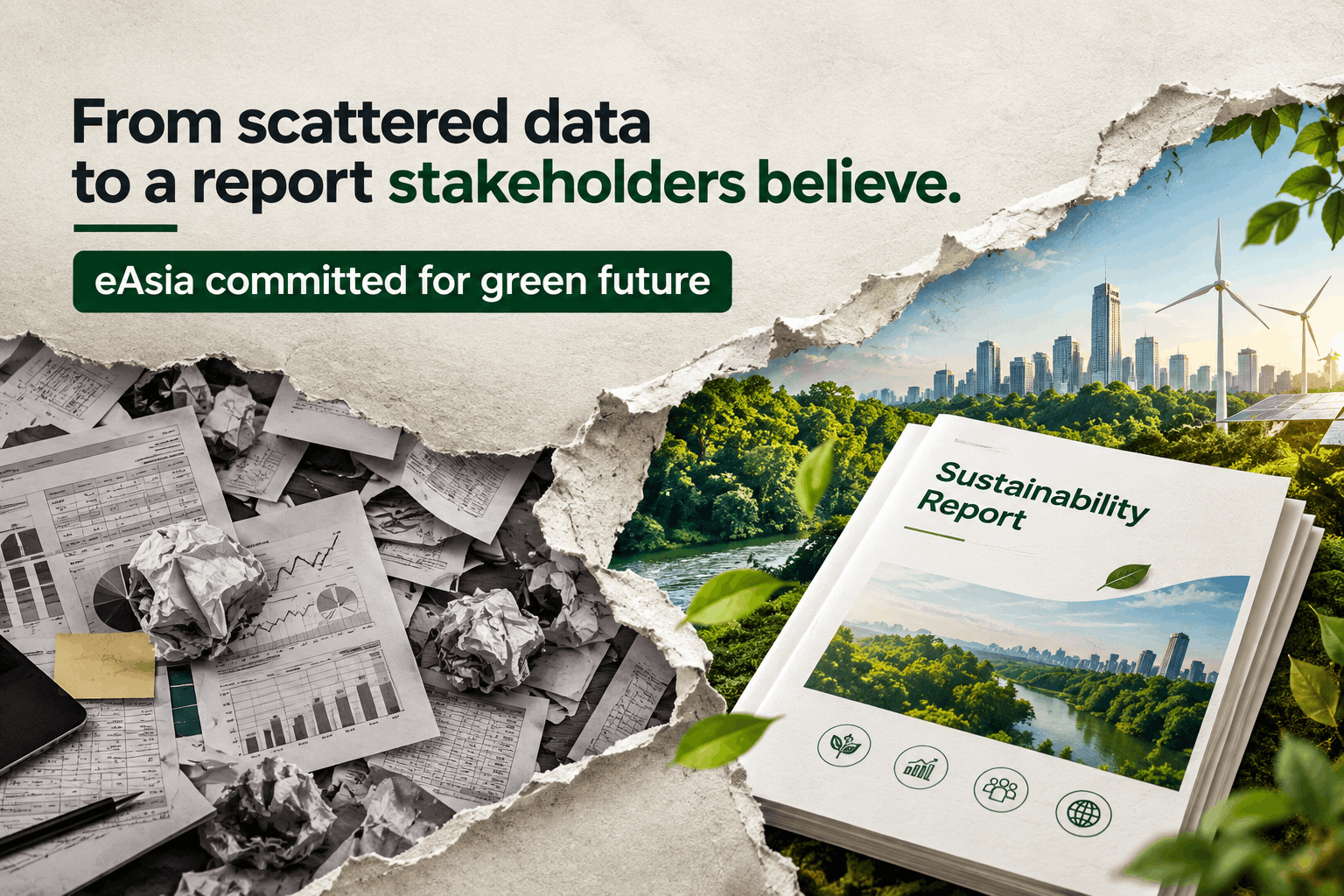
Sustainability reporting provides an evidence-based ESG story.
BRSR, GRI, and ISSB each have distinct roles.
Effective data gathering can make or break a report.
Skilled sustainability reporting is in high demand in India.
Rahul is a finance manager at a textile export company in Tiruppur. One Monday morning, he receives an email from the company's biggest European client. "Would you kindly provide us with your latest sustainability report before the next contract review?" it says, politely but firmly.
And there lies the rub: The company does not have one.
By noon, Rahul comes up with five more questions and no answers: In which format do we present our report? Where do we find information on our energy consumption? Who monitors the safety of our workers? And what about the carbon footprint of our dyeing facilities?
This might sound familiar to you, and that's because thousands of other Indian businesses are going through this very experience right now. The good news here is that writing a sustainability report is something that can be learned and practiced. This eAsia Academy guide will take you through it, one step at a time.
01What Is ESG Reporting and What Is a Sustainability Report?
ESG reporting refers to the process of measuring and communicating performance in environmental, social, and governance areas. These could include carbon footprint, water usage, employees' health and safety, diversity, ethical behaviour, corporate governance, and other.
Sustainability reports are one of the end products of this process. It is a structured document that answers the following questions in a systematic way:
- What is important? The material ESG issues of the company.
- What do we do about them? The policies, goals, programs, and governance in place.
- What results have been achieved? Data and trends on ESG performance.
ENVIRONMENT:
- Energy use & GHG emissions (Scope 1–3)
- Water withdrawal & discharge
- Waste & circularity
- Biodiversity & land use
- Climate risks & targets
SOCIAL:
- Employee health & safety
- Diversity & inclusion
- Human rights in supply chains
- Training & skill development
- Community engagement
GOVERNANCE:
- Board oversight of ESG
- Ethics & anti-corruption
- Risk management
- Data privacy & cybersecurity
- Transparent BRSR / GRI disclosure
The three ESG pillars every sustainability report is built on. eAsia committed for green future.
In other words, your financial report describes the ways in which the organization earns its income. In turn, the sustainability report demonstrates how it earns money responsibly, and what measures it takes to address the future challenges. Every credible report is based on the three pillars of ESG shown above, which is also the starting point of ESG reporting training.
02Why Every Indian Company is Being Demanded to Provide One
Some years ago, sustainability reports were created mostly by large companies who cared about their image. Today, the demand is coming from all sides.
- Authorities: SEBI mandates the top 1,000 companies listed in India to provide a Business Responsibility and Sustainability Report (BRSR) and a phased assurance requirement of key BRSR Core indicators at the largest companies.
- Foreign buyers: Exporters in textiles, automotive components, pharmaceuticals, chemicals, and IT have been asked to provide ESG metrics as a prerequisite to trade.
- Financing: Lenders and investors take sustainability into account when making decisions on extending credits and investing.
- Talent: Young employees check the sustainability report of the potential employer before joining.
In short, a sustainability report has moved from a "nice to have" to a business passport. At eAsia Academy, this is exactly why eAsia committed for green future places reporting skills at the heart of our ESG certification program.
03The Frameworks You'll Actually Use
The "alphabet soup" of ESG frameworks scares a lot of first-time reporters. In reality, most Indian companies work with a handful, and each one does a different job. Here's a quick reference.
| Framework | What It Does | Main Audience | Relevance in India |
|---|---|---|---|
| BRSR (SEBI) | Format of mandatory disclosure of ESG information for nine principles of responsible business | Regulators, investors | Mandatory for top 1,000 listed companies |
| GRI Standards | Reporting about impact on economy, environment and society | All stakeholders | Most common base for standalone reports |
| ISSB (IFRS S1 & S2) | Disclosures of sustainability and climate risks and opportunities relevant to investors | Investors, lenders | Growing adoption among large and export-led firms |
| GHG Protocol | Calculating of Scope 1, 2 and 3 greenhouse gas emissions | Everyone reporting carbon data | Used behind almost every emissions figure |
| CDP | Questionnaire disclosure of climate, water and forest issues | Investors, global buyers | Often requested by multinational customers |
A more practical solution to this problem? Begin with what is mandatory or requested (BRSR or questionnaire by your buyer) and then build on it using GRI as your framework, incorporating climate disclosures aligned with ISSB as you mature. You can learn this through Indian case studies.
04How to Prepare a Sustainability Report in 8 Steps
Here's the process strong reporting teams follow. Rahul's company used exactly this sequence for its first report.
Step 1: Define the scope and reporting boundary
Decide the reporting period (usually the financial year), which entities, plants, and offices are included, and whether you'll cover the value chain. A clear boundary stops confusion later when numbers don't add up.
Step 2: Set up governance and a core team
Appoint a reporting lead and name a data owner in every function: operations for energy and water, HR for people data, procurement for suppliers, finance for spending, and legal for policies. Get a senior sponsor who can unblock delays.
Step 3: Find your material issues
Perform a materiality test to determine what issues should go into your report. "Double materiality," which considers both your effect on the environment and the environment's effect on your finances, is covered thoroughly in our sustainability reporting course.
Step 4: Choose your framework and align your indicators
For every material topic, choose the specific disclosure to be made as per BRSR, GRI, or ISSB. This makes a data request form that specifies exactly what information you need from each data owner.
Step 5: Gather, Calculate and Validate Data
This is the tough part. Use the standard template format, require supporting documents like electricity bills and payroll documents, calculate your emissions based on emission factors and validate every figure with last year's numbers. Any discrepancies should have reasons. This is part and parcel of ESG data gathering training.
Step 6: Targets and progress tracking
Stakeholders need more than data; they need direction. Provide time-bound targets regarding critical areas such as emissions, water use, safety, and diversity. Also include an honest assessment of progress.
Step 7: The narrative
Tell a story with the data. Tell what happened, why it happened, and what will be done next. Use clear writing, specific examples from the shop floor, and charts that show clear trends. Include both successes and failures.
Step 8: Review, assure, and publish
Gain internal review and approval from management and the board, get independent assurance on critical indicators where appropriate, and publish the report on the website with a GRI or BRSR content index.
The quality of a sustainability report is only as good as the data behind it. Get the data straight, and writing the report becomes easy.
Want to lead your company's next sustainability report?
Learn BRSR, GRI and ISSB-aligned reporting, ESG data collection and report writing through real case studies in our IIT Roorkee-partnered program, built for working professionals across India.
05What Goes Inside a Strong Sustainability Report
While every report is different, most credible ones follow a familiar sustainability report format:
- Leadership message that sets the tone and names real priorities
- Company profile covering operations, products, and value chain
- Materiality and stakeholder engagement section explaining what matters and why
- ESG governance showing who oversees sustainability at board level
- Environmental performance on energy, emissions, water, waste, and biodiversity
- Social performance on employees, safety, diversity, communities, and suppliers
- Governance performance on ethics, anti-corruption, data privacy, and risk
- Targets, content index, and assurance statement at the end
Each of these sections is practised step by step in the Professional Certificate Program in ESG & Sustainability Reporting.
Environment
Energy, carbon, water, waste
Social
People, safety, communities
Governance
Ethics, board, risk
Targets
Clear goals and progress
06Mistakes That Cost Credibility
A beautifully designed report can still fall flat. These are the errors reviewers and investors spot fastest:
- Glossy photos, thin data. Pictures of saplings don't replace emissions figures.
- Only good news. Reports that hide safety incidents or missed targets lose trust instantly.
- Inconsistent numbers. Figures that don't match the annual report or BRSR raise red flags.
- Vague claims. Words like "eco-friendly" or "green" without evidence edge towards greenwashing.
- Starting too late. Collecting a full year's data in the final month almost guarantees errors.
The fix for most of these is simple: start early, document everything, and be honest. At eAsia Academy, we teach reporting teams to build these habits from day one.
07Advantages of an ESG Reporting Skillset in Your Career Path
After five months, Rahul's employer released its first report, and the buyer continued working on the contract. Rahul was also asked to set up a long-term ESG reporting team. A one-off assignment evolved into a full-fledged career path. That’s why professional experts in India choose eAsia Academy for upgrading their skills.
In India, there is a rising demand for those who can draft credible sustainability reports. Such specialists are needed at listed companies, exporters, consulting organizations, audit firms, and financial institutions. Typical positions in this field are:
- ESG Reporting Analyst and Sustainability Report Writer
- BRSR Expert and ESG Assurance Associate
- ESG Data Manager (KPIs & Reporting)
- Sustainability Manager
It’s easy for finance, audit, operations, and HR professionals to change their career path into ESG reporting because they are familiar with the data. For instance, HR professionals possess the vast majority of social data in each report and can enhance their expertise with social disclosure standards from our ESG reporting certification.
08Learn ESG Reporting with eAsia Academy
At eAsia Academy, we believe good reporting is a skill, not a template. That belief sits behind eAsia committed for green future and every program we deliver in academic partnership with IIT Roorkee.
Our Professional Certificate Program in ESG & Sustainability Reporting takes you through the full reporting cycle: materiality, BRSR, GRI and ISSB-aligned disclosures, ESG data collection, report writing, and assurance readiness, using practical Indian case studies.
Whether you're a finance professional, an auditor, an HR leader, or a fresh graduate, the ESG & Sustainability Reporting certification gives you a portfolio-ready understanding of how real reports are built.
Ready to build a career in ESG reporting? Explore the program and apply today or discover all eAsia Academy programs.
FAQs
ESG reporting refers to the entire process of measuring and reporting performance on environmental, social and governance factors. A sustainability report is an output of ESG reporting that explains the material aspects of the company, how it has been managing them, and its performance during the financial year.
As per SEBI norms, the top 1,000 companies by market capitalisation have to submit the Business Responsibility and Sustainability Report as part of the annual report. While a standalone sustainability report is not mandatory, many companies prepare one due to investor and customer expectations.
The BRSR framework is required for listed Indian companies. Apart from this, the GRI Standards framework is preferred by many new reporters since it is internationally recognized and applicable to a wide range of impacts. Companies with investor interest may also provide ISSB-aligned climate disclosures under IFRS S2. All three are covered in our ESG reporting program.
Developing a first report can take about four to six months from the initial scoping phase to the final draft, with data gathering being the most time-consuming activity. Once systems, templates, and data owners are established, later reports can take about two to three months to produce.
Typical data includes energy usage, greenhouse gas emissions under Scopes 1, 2 and, where possible, Scope 3, water withdrawal and discharge, waste generated and recycled, headcount, diversity, training hours, health and safety cases, supplier assessments, community expenditure, and governance measures such as ethics and anti-corruption.
External assurance of standalone sustainability reports is not mandatory; however, it can improve the credibility of the report. In India, SEBI has introduced a phased approach to assurance or assessment for certain key BRSR Core indicators for the largest listed companies.
The Professional Certificate Program in ESG & Sustainability Reporting, offered in academic partnership with IIT Roorkee, covers materiality, BRSR, GRI and ISSB-aligned reporting, ESG data collection, and report writing through practical case studies designed for working professionals in India.