HR Analytics vs Traditional HR: Which Career Path Pays More in 2026?
It's 11 p.m. and Neha, HR manager at a mid-sized Bengaluru organization, is awake – not because she needs to chase more candidates, but because she can't fathom why her top sales hires leave within eight months. Somewhere across town, a colleague at a competing organization pulls up a dashboard, filters by department and tenure, and has the answer in ninety seconds. The same job title. The same number of years of experience. Different arsenal entirely.
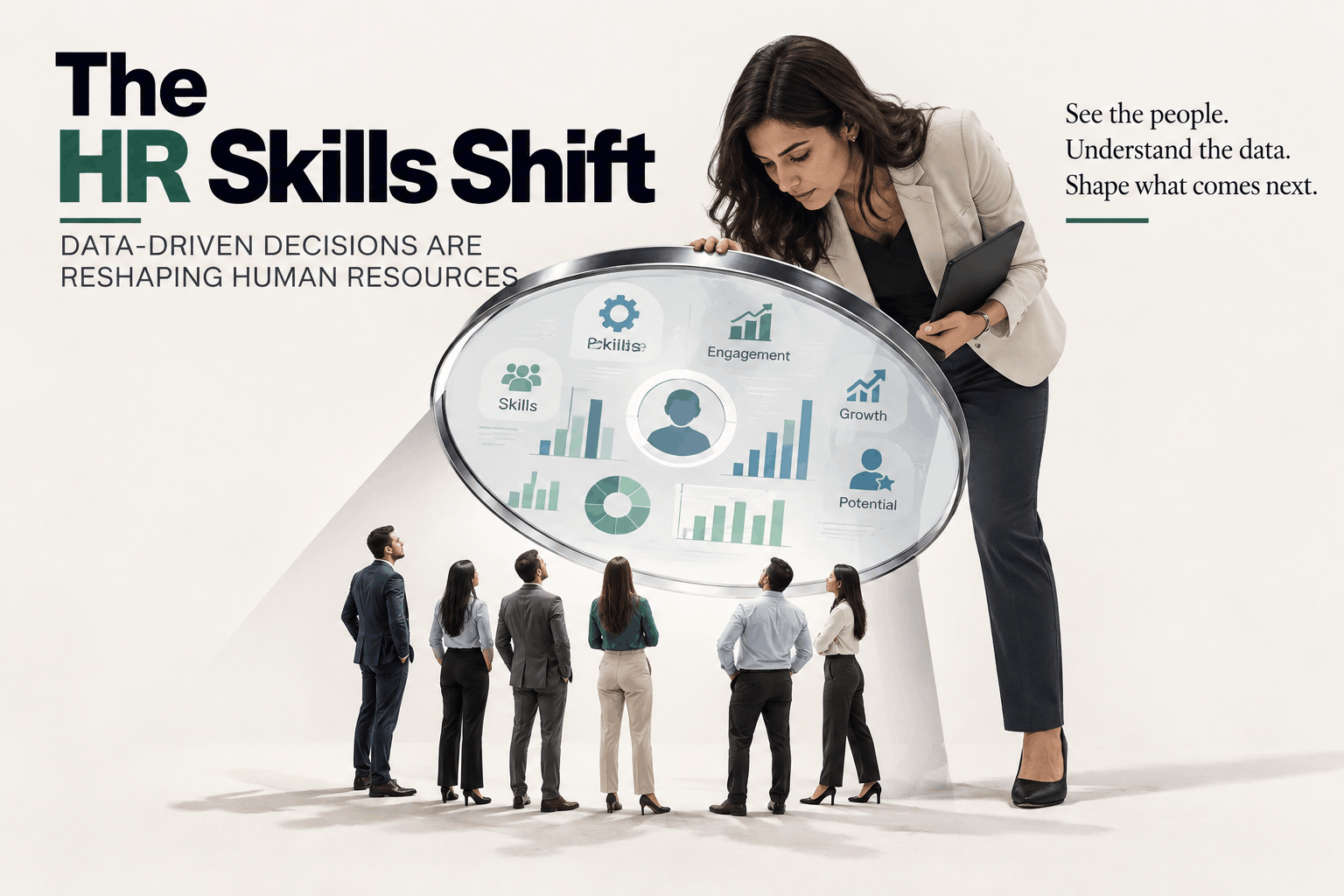
HR Analytics roles can offer 30-45% higher salaries
AI is transforming recruitment, attrition and performance
Certification can build HR analytics skills faster
Demand for analytics-savvy HR professionals is growing
This is not about talent. This is about HR Analytics HR Analytics and how it is slowly becoming the distinction that defines whether an HR professional gets promoted or finds himself/herself explaining what went wrong afterwards.
This guide details the differences between a career in HR versus HR Analytics from salary and skill set perspectives in India – along with how to decide which one is right for your future.
01The HR Job Market Is Silently Splitting Up into Two
Five years ago, "HR professional" was a single career lane with a few specializations — recruitment, employee relations, compliance, L&D. Today, that lane has forked. On one side sit traditional HR roles that still run largely on process, policy, and judgment calls. On the other sit HR Analytics and AI-driven roles where decisions are backed by dashboards, predictive models, and measurable outcomes.
The Indian firms, from IT giants to rapidly growing startups, are recruiting in large numbers in the latter category. And the job postings for "People Analytics," "HR Data Analyst," and "AI-driven Talent Acquisition" have skyrocketed in the last couple of years. The unpleasant news for HR professionals who belong to the former category is that their job market doesn't disappear; it flattens – no raises, slow promotions, and fewer manager roles.
“The most successful HR leaders of the next decade will not be the ones who feel people the best — they will be the ones who can prove their feelings with data.”
02The Reality of Traditional HR Jobs
Traditional HR remains a pillar of all organizations, and will remain so for the foreseeable future. It includes:
- Recruitment coordination – from sourcing to interviewing
- Employee relations – grievances and disputes, culture management
- Compliance and policies – labour laws, filing and onboarding
- Performance management – appraisal and documentation, manager coaching
This work requires strong communication skills, confidentiality and organizational knowledge – skills which truly cannot be automated. And because the results of this work are not easy to quantify, defending them during budget discussions can be challenging – hence lower salaries in traditional HR compared to analytics-focused positions.
03What HR Analytics Roles Look Like Today
While HR Analytics experts perform most of the standard HR functions, they do so use data. Their usual weekly schedule may include:
- Creating a model for employee turnover predictions, allowing managers to identify potentially leaving employees ahead of time.
- Generating a time-to-hire dashboard to highlight areas where there is a leak in the recruiting funnel.
- Utilizing AI-based candidate tracking software to make the screening process faster and unbiased.
- Presenting workforce costs and productivity metrics straight to management.
That is exactly what companies are ready to pay extra for – HR professionals who come to management with numbers rather than opinions.
04Side-by-Side: Traditional HR vs HR Analytics
| Dimension | Traditional HR | HR Analytics & AI |
|---|---|---|
| Core Focus | Employee relations, compliance, admin | Predictive workforce insights & data storytelling |
| Primary Tools | HRMS, Excel, manual trackers | Power BI, basic SQL, AI-driven ATS platforms |
| Decision Basis | Experience & intuition | Data models & measurable outcomes |
| Career Ceiling | HR Manager / HRBP | Head of People Analytics, CHRO track |
| In-Demand Skills | Employee engagement, onboarding, ER | Attrition prediction, dashboarding, AI recruitment |
| Hiring Demand (2026–2030) | Stable, slower growth | High growth, actively hired for |
05Why the Salary Gap Exists (and Is Increasing)
The salary gap is not because of the HR Analytics professional being more hardworking, but rather because of visibility. If an HR Analytics professional is able to make the CFO see clearly the financial losses incurred from a 15 percent attrition rate or the ability to reduce the hiring process by ten days through the use of a different recruiting source, then such activities are directly linked to bottom-line profits and costs savings.
The more Indian firms create People Analytics teams and implement AI-based HR systems, the more this gap increases.
Ready to Move from Reactive HR to Data-Driven HR?
eAsia Academy's HRMA program is built with IIT Roorkee academic partnership to help working HR professionals build exactly this skill set — without quitting their jobs. eAsia committed for green future, and equally committed to building the HR leaders who will run tomorrow's data-driven workplaces.
06The soft skill required in AI recruitment
Everyone does not have to be an analyst to take advantage of this transformation. Here's an easy self-test depending on who you currently are:
The Relationship Specialist
Enjoys dealing with employee relations. Best move: enhance your current role by adding an analytical component.
The Data-driven HR Professional
Pulls data and likes the "why." Best move: go all the way in becoming an expert in HR Analytics.
The Career Changer
Moving from Finance, Operations, or IT roles into HR. Best move: get an HRMA certification, not just an HR one.
The Future CHRO
Looking at leadership within 5-8 years. Best move: combine both analytics and strategic HR knowledge now.
07Transitioning Without Starting from Scratch
The bright side of the story is that shifting towards HR analytics does not mean that everything previously done must be thrown away. The key elements of any smooth transition remain the same:
- Begin with creating one dashboard. Focus on one recurrent HR issue – employee turnover, time to hire, absenteeism — and master the art of tracking it.
- Master the skills which will be checked by recruitment specialists – Power BI, basics of SQL, and AI-powered applicant tracking systems, but not advanced data science.
- Obtain a relevant and structured HR-oriented certification – rather than taking some general data-related course.
- Use data in the meetings you attend – this way, the visibility will be obtained much faster compared to changing your job title.
This is exactly the point where a specialized HR analytics program can help.
08eAsia Academy’s HRMA Program: Your Fastest Bridge
eAsia Academy’s Professional Certificate in HR Management & Analytics Using AI (HRMA), with academic accreditation from IIT Roorkee, is designed exclusively for active HR practitioners and is aimed at providing you with the analytics portion of the comparison without changing your current employment or having to begin a new career as a programmer. The course teaches HR-related data analysis, AI-based recruitment and retention technologies, and dashboarding in a way directly relevant to your future HR decision-making.
If the path to your future career in People Analytics, HR management or just more influence in the leadership of your organization, lies somewhere close to those points, this is the fastest bridge there is. And if you are thinking about careers related to sustainability or climate change, eAsia Academy's ESG & Sustainability Reporting and Carbon Credits, Carbon Markets & Net-Zero Pathways programs sit under the same IIT Roorkee-backed umbrella — eAsia committed for green future, across every certification it offers.
FAQs
HR Analytics employs analysis of employee information, use of visual displays of information and prediction of trends for making hiring, retaining and performance management decisions, whereas conventional HR involves more processes, compliance and employee relationships. HR Analytics enhances the HR approach with the element of measurability and analytics.
No. In the majority of cases, HR Analytics requires familiarity with Excel, Power-BI, SQL and other analytic tools, not with software development. Courses such as the one at eAsia Academy for HRMA do not require any background in coding from an HR practitioner.
Yes. The Professional Certificate in HR Management & Analytics Using AI is built for working HR professionals and starts from foundational concepts before moving into applied AI and analytics tools used in real hiring and retention decisions.
This certification program is structured in a way that one can complete it while still doing their full-time job.
Certification itself won't necessarily make you get promoted sooner, but your ability to share data-driven workforce insights is one of the most obvious factors that sets HR managers apart from others today in trying to earn leadership positions or positions in people analytics.
Artificial intelligence is used to automate routine HR operations like reviewing resumes and scheduling interviews, but at the same time increases the need for HR specialists able to interpret these insights provided by AI algorithms.