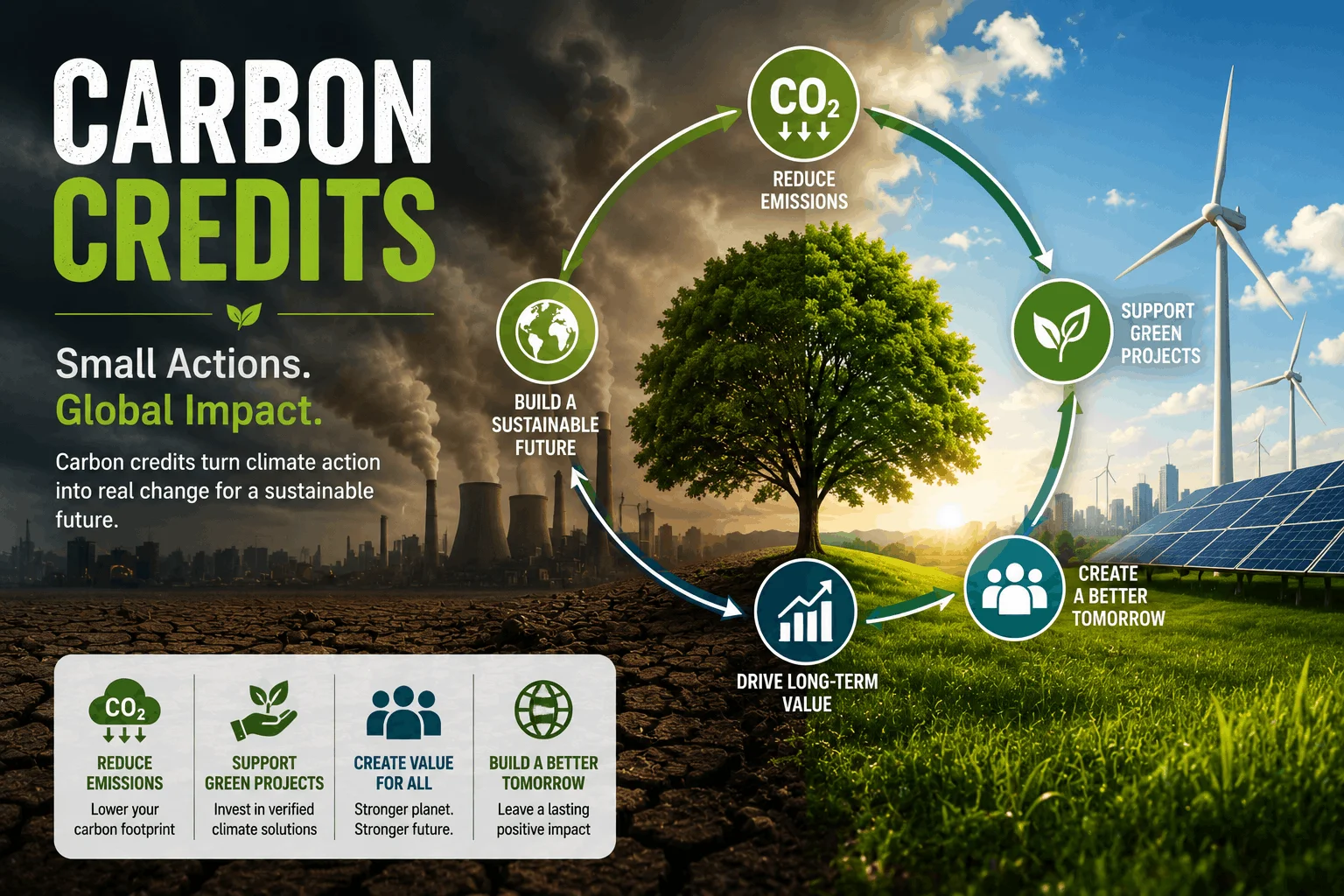
Carbon Credits vs Carbon Offsets: What Is the Difference?
What Is a Carbon Credit?
In general, carbon credit means a tradable unit with the increasing awareness about climate change and sustainability by governments, businesses, and individual people, such terms as carbon credits and carbon offsets start to frequently appear in our daily conversations. Although sometimes they are used interchangeably, the definitions of both are not the same.
To understand what's the difference between carbon credits and carbon offsets is of high significance for professionals in the field of sustainability, businesses and investors, as well as any people interested in this booming market of carbon trade.
In brief, carbon credit represents one unit quantity reduction in greenhouse gas emissions, while carbon offset is typically attributed to using some verified emission reductions or removals in order to make up for the emissions produced in somewhere.
In this article, you will learn the difference between carbon credits and carbon offsets, how they work, their connection to carbon markets and the importance of understanding them for businesses and practitioners alike.
Which represents one metric tonne of carbon dioxide equivalent which is avoided, reduced or removed depending on the relevant market, program and methodology.
Carbon credits can be issued through the implementation of projects that reduce or remove greenhouse gas (GHG) emissions from the atmosphere.
Examples of such projects are:
- Renewable energy projects
- Methane avoidance schemes
- Reforestation and afforestation programs
- Enhanced forest management projects
- Energy efficiency projects
- Landfill gas schemes
- Carbon removal technologies
- Some agricultural practices
When a project can prove that it has met the requirements for reducing or removing eligible greenhouse gas emissions according to an appropriate standard or protocol, credits may then be issued and possibly traded.
The nature of a carbon credit will depend on various things like methodology, project design, measurement, verification, additionality, permanence, and registry/market that applies.
What Is a Carbon Offset?
Carbon offset refers to the process through which one uses an eligible emission reduction or removal to offset emissions taking place somewhere else.
For instance, let’s assume that an organization is responsible for emissions because of conducting its operations. This organization could fund a climate project that eliminates or avoids an equivalent number of greenhouse gas emissions.
The carbon credits will be used by this organization in claiming offset, depending on certain conditions and the nature of the credits.
Thus, carbon offsets are very related to carbon credits, although they are different things.
Carbon credit is the unit, and carbon offset is the application of the unit to compensate for emissions.
Carbon Credits vs. Carbon Offsets: What’s the Main Difference?
The best way to explain the difference is:
Carbon credit: This is a quantifiable unit that reflects emission reductions or removals.
Carbon offsets: This involves using emission reductions or removals to balance out emissions somewhere else.
It should be noted, however, that the language may change depending on whether you are working in voluntary or compliance markets, among other things.
| Carbon Credits | Carbon Offsets |
|---|---|
| Are a quantified reduction, avoidance, or removal of emissions. | Usually relate to compensation for emissions through eligible reductions or removals. |
| May be created through projects that qualify for an offset purpose. | Most often relate to the retirement or cancellation of credits for an offset claim. |
| May be bought, sold, or otherwise transferred, depending on the market. | Most often relate to the application of credits for an offset purpose. |
| Exist without the intention of making an offset claim. | Most often relate to the application of credits for compensation. |
| Are found in various carbon market settings. | Most often relate to voluntary climate compensation. |
How Do Carbon Credits Work?
The carbon credit cycle could include a number of phases.
1. Project Development
In this phase, a project that reduces, avoids, or captures greenhouse gases is developed.
The project could entail setting up renewable energy technologies or capturing methane that otherwise would end up in the atmosphere.
2. Methodology and Project Evaluation
A methodology or program criteria needs to be adhered to by the project.
The methodology determines how to quantify and monitor emission reductions or removals.
3. Monitoring
Monitoring entails tracking the project actions and associated emissions over time.
Monitoring is very crucial since carbon credits hinge on measurable climate benefits.
4. Verification
It will be required for the project to go through verification or validation to meet the conditions of the relevant program if it is needed.
Verification aims to ensure that the emissions reductions or removals have met the relevant conditions.
5. Credit Issuance
In the case that the project has met the relevant conditions, carbon credits will be issued using a relevant registry or system.
6. Trading or Transfer
The credits may be transferred or sold to another party who is eligible according to the rules of the relevant market.
7. Retirement
Once the credits have been used for specific offset purposes, they may then be retired or cancelled.
Retirement of credits is very important when credits are used for the offset purposes.
How Do Carbon Offsets Work?
Suppose a company calculates that it has emitted 1,000 tonnes of CO₂ during a particular period.
The company first needs to understand and reduce its own emissions as far as reasonably possible.
For remaining emissions, it may choose to use eligible carbon credits to compensate for an equivalent amount, where such an offsetting approach and claim are permitted.
If 1,000 eligible credits are used and properly retired for that purpose, those credits should no longer be available for someone else to claim.
This illustrates why retirement and clear ownership are important concepts in carbon markets.
Should Companies Reduce Emissions or Buy Offsets?
Carbon offsets should not generally be viewed as a substitute for reducing a company's own emissions.
A stronger climate strategy usually begins with:
Measure → Reduce → Remove residual emissions where appropriate → Address remaining emissions through credible mechanisms where suitable
Companies can start by measuring their greenhouse gas emissions and identifying their major sources.
They can then work on reducing emissions through:
- Renewable energy
- Energy efficiency
- Sustainable transportation
- Supply-chain improvements
- Waste reduction
- Process improvements
- Low-carbon technologies
After reducing emissions, organizations may consider appropriate carbon market mechanisms for remaining emissions, subject to relevant standards, regulations, and credible claims practices.
Why is Quality of Carbon Credits Important?
All carbon credits do not possess the same features or qualities.
The following should be considered before buying or using carbon credits:
Additionality
Would the emission reduction or carbon removal have occurred in the absence of carbon financing or the project methodology?
Permanence
How permanent is the carbon removal or storage claimed in nature-based projects?
Measurement
Have the emissions reductions or removals been measured properly?
Verification
Has the project been independently verified?
Leakage
Is there the possibility that emission reduction in one area may lead to an increase in emissions somewhere else?
Double Counting
Is the same emissions reduction or removal being claimed more than once?
These factors are important when assessing the credibility and environmental integrity of carbon credits.
Voluntary vs Compliance Carbon Markets
Carbon credits can be used in different market contexts.
Voluntary Carbon Market
In the voluntary carbon market, organizations and other participants may purchase and retire credits for voluntary climate-related purposes, subject to applicable standards and claims guidance.
Companies may participate in voluntary markets as part of broader climate or sustainability strategies.
Compliance Carbon Market
The compliance market is run within the context of regulations set out by government entities or others.
Entities may be required to achieve certain emissions requirements based on jurisdiction and industry.
There could be substantial differences between compliance and voluntary markets regarding the rules for units, trading, reporting, and claims.
Why Does This Matter to ESG Professionals?
Carbon markets have become ever more linked with corporate sustainability and ESG.
If professionals in ESG have to know:
- how to measure greenhouse gas emissions,
- the different types of emissions – scope 1, 2, and 3,
- carbon credits,
- carbon offsets,
- carbon markets,
- climate risks,
- net-zero approaches,
- ESG reporting, and
- sustainability claims,
then having an understanding of carbon markets is something useful to ESG Analysts, Sustainability Managers, Carbon Consultants, ESG Reporting Professionals, and other sustainability experts.
Career Opportunities in Carbon Markets
The growth of carbon markets is creating opportunities across several areas.
Professionals can explore roles such as:
- Carbon Credit Analyst
- Carbon Market Analyst
- Sustainability Analyst
- ESG Analyst
- Carbon Consultant
- Climate Risk Analyst
- Carbon Project Specialist
- Sustainability Consultant
- ESG Reporting Professional
People entering this field can benefit from combining carbon market knowledge with skills in data analysis, sustainability reporting, finance, project evaluation, and ESG.
Carbon Credit versus Carbon Offset: An Easy Example
Think of a company that emits 10,000 tonnes of CO₂ per year.
The firm monitors its emissions and takes energy efficiency and renewable energy measures which result in reduced emissions to 7,000 tonnes.
The firm then decides whether and how to deal with the remaining emissions in terms of climate actions.
In case the firm employs eligible Carbon credits and retires them for the purpose of offsetting, the retired carbon credits can be used in making a corresponding claim, provided that the relevant standards and claims rules are satisfied.
The main thing here is that carbon credits are units, while carbon offsets are a way to use emissions reduction/removals to offset emissions somewhere else.
Final Thoughts
There is a connection between carbon credits and carbon offsets; however, the two are not quite the same.
A carbon credit typically relates to a unit that is quantified with regard to emission reductions, avoidance, and/or removals.
A carbon offset typically involves the use of emissions reductions and/or removals to offset emissions that have been emitted somewhere else.
As the carbon markets continue to evolve, knowledge of these terms will be increasingly valuable for corporate entities as well as sustainability experts.
In case you are interested in establishing yourself in the carbon market space, ESG, or sustainability, gaining an understanding of carbon accounting, carbon credits, carbon markets, climate strategy, and ESG reporting will serve as an excellent stepping stone.
Through its eAsia Academy, eAsia helps professionals gain relevant industry knowledge through courses in ESG, Sustainability, and Carbon Credits.
FAQs
No. Although the terms are often used interchangeably, they describe different concepts. A carbon credit is generally a quantified unit representing an emissions reduction, avoidance, or removal. A carbon offset generally refers to using an eligible reduction or removal to compensate for emissions elsewhere.
In many carbon market systems, one carbon credit represents one metric tonne of carbon dioxide equivalent (1 tonne CO₂). The exact characteristics and eligibility of a credit depend on the applicable market, standard, methodology, and program.
Yes. Carbon credits may be traded or transferred in applicable voluntary or compliance market systems, subject to the rules governing that market or registry.
When a credit is retired, it is taken out of circulation and should no longer be available for another party to use. Retirement is an important mechanism for preventing the same credit from being claimed multiple times.
Carbon offsets should not generally be treated as a substitute for reducing an organization's own emissions. Companies should prioritize measuring and reducing emissions before considering appropriate offsetting or other carbon market mechanisms.