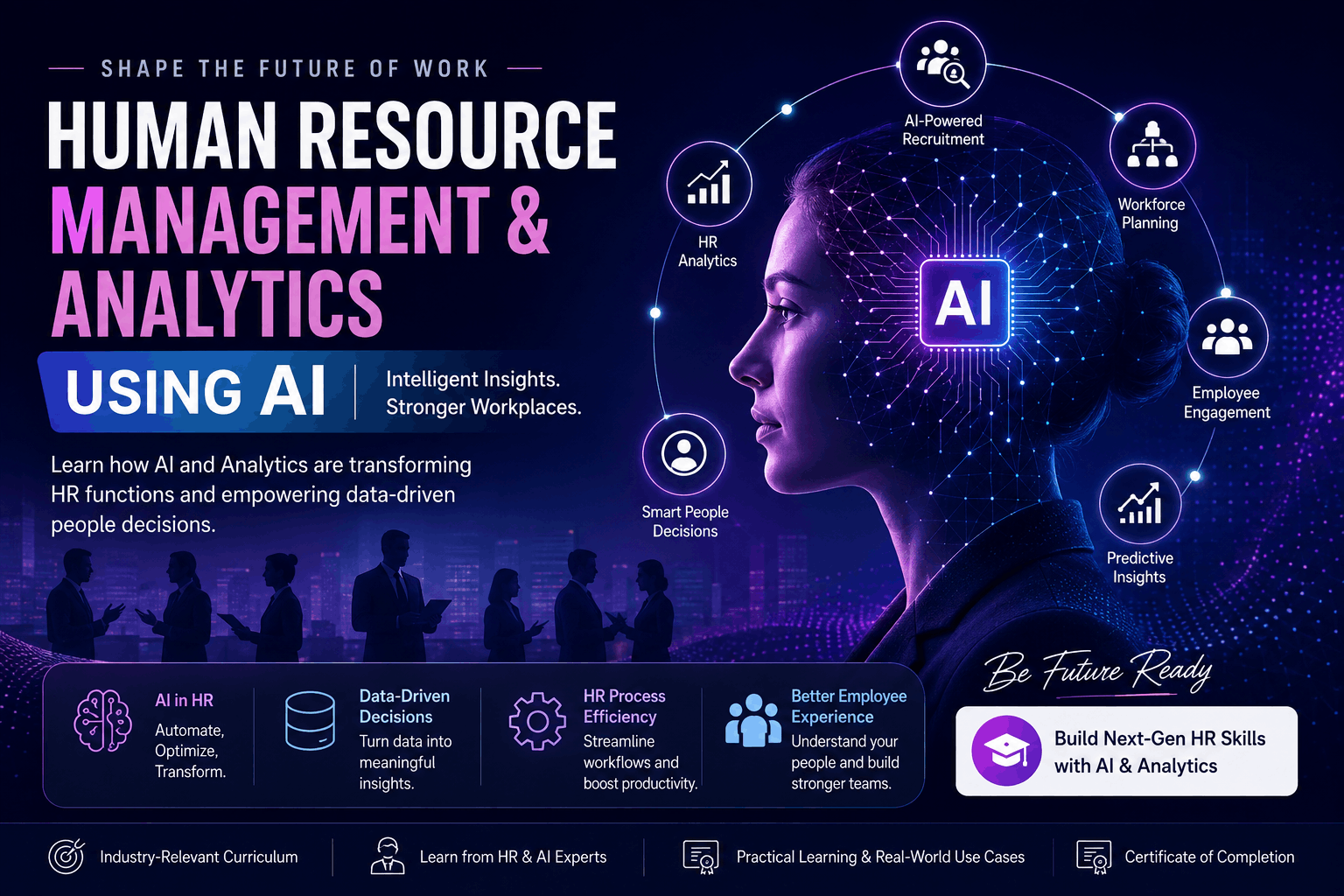
Human Resource Management & Analytics Using AI: The Future of HR
The Human Resource sector has undergone significant changes in recent times. Previously, the main concerns of Human Resources consisted of employee hiring, keeping records, attendance tracking, and addressing employee queries.
In our times, organizations have started to incorporate AI and data analytics in their HR departments for better decision-making regarding workforce planning and employee engagement.
This shift has led to higher demand for professionals who are experts in both managing Human Resources and analytics using AI. Human Resource managers are supposed to manage people properly and understand the trends in data management.
The course Human Resource Management & Analytics Using AI is aimed at facilitating the understanding of the relationship between HR practices and data analytics.
It is a good opportunity for students and graduates to learn how AI and analytics are used in Human Resource management.
How AI Is Transforming Human Resource Management
The emergence of AI technologies is revolutionizing the manner in which businesses implement various HR processes. The use of technology in carrying out operations such as the automation of monotonous tasks, processing massive amounts of data, upgrading the hiring procedure, and gaining information about the workforce is becoming more common among organizations.
AI tools can assist recruiters in managing applications and optimizing one or several steps of the recruitment process. Moreover, data analytics can enable organizations to analyze human resource trends and comprehend the factors behind such phenomena as the performance of employees and their retention rate.
However, technology cannot replace the human aspect of HR management. In fact, AI can support professionals in HR management by allowing them to minimize the amount of paperwork and devote sufficient time to strategic processes that require human reasoning.
The understanding of the application of AI in Human Resource Management is becoming an increasingly demanded skill.
What Is HR Analytics?
HR analytics, also referred to as people analytics or workforce analytics, is all about leveraging HR-related data to comprehend the patterns of the workforce and facilitate effective decision making.
HR departments have to put a lot of effort into collecting data through recruitment and onboarding, maintaining employee records and data on employee performance, monitoring attendance and participation level of the employees and other processes. Proper analysis of the HR-related data can bring in useful results.
HR analytics is helpful in finding trends in terms of turnover of employees, performance of the recruitment process, analysis of the workplace human resources needed or engagement levels reflected by other processes.
HR professionals don’t have to rely only on their assumptions but can make fact-based decisions. By studying HR analytics one can develop more analytical mindset in terms of managing people.
Why Should HR Professionals Learn AI and Analytics?
The role of human resources continues to become more integrated within technology and data. Businesses expect human resources teams to have an understanding of business needs as well as become involved in strategic decision-making as a result of data processes.
Learning about artificial intelligence and analytics means that professionals in the human resources sector can understand the role of technology in different functions relevant to human resources and boost their analytical skills.
Someone with a typical background in human resource management and knowledge about the basics of analytics can provide the organization with a fresh outlook on the issues faced.
It is important to understand something beyond the implementation of artificial intelligence tools, including where technology can bring benefit and how the information should be described.
In this case, the mixture of human resource management, analytics, and artificial intelligence technologies makes it possible for professionals to get ready for the future changes in the job market.
AI-Powered Recruitment and Talent Acquisition
Recruitment is a vital part of Human Resources and the coming of technology to the recruiting process of organizations has been able to change everything.
Digital and automated processes, use of data analysis, AI-based devices, tools and procedures are all a part of the modern-day recruiting cycle that can help HR specialists in dealing with thousands of applications, organizing their recruiting process and making it easier for them.
It does not, however, mean that proper recruitment is unimportant. It is important for employees in recruiting to know the significance of being fair in their decision-making process, work with data, and oversee and evaluate all candidates.
Finally, the AI should always be regarded as a tool to help the Human Resources professionals make better decisions.
The Importance of Data-Driven HR Decisions
Data analysis is a significant step made in moving from making reactive decisions by HR professionals to more informed decision-making.
For example, companies can utilize workforce data to determine recruitment trends, employee turnover rate, workforce availability, and engagement levels. This information allows HR professionals to ask proper questions and formulate effective strategies.
Nevertheless, data is not the only thing that answers questions. Quality of data, context, and ethical matters are extremely important.
Good knowledge of combining data analysis with business experience and knowledge of people is what makes an HR professional successful.
This is one of the major reasons why HR Analytics training is becoming more popular nowadays.
Skills You Can Build Through Human Resource Management & Analytics Using AI
In order to succeed in the future of Human Resource activities, there must be a combination of soft skills, business awareness, analytical ability, and technological knowledge.
As a result of training in the field, professionals will be capable of gaining a deeper insight into the principles of Human Resources, as well as how analytics can help in making decisions about the workforce. They will be able to learn whether Artificial Intelligence has an impact on HR activities and whether data is becoming increasingly relevant for contemporary organizations.
The key areas of knowledge that are worth acquiring include core HR principles, recruitment and talent acquisition fundamentals, principles of HR data, analytical thinking, workforce insights, employee engagement, Artificial Intelligence in HR, digital transformation in HR, and legal principles of technology application.
It is important to mention that human communication remains critical. Despite the rapid technological development, HR is about people. The ability to empathize, communicate, and apply ethical decision-making is essential.
Who Should Consider This Course?
The Human Resource Management & Analytics Using AI program can benefit a range of learners.
Beginners and students wishing to understand the future of HR will become familiar with the correlations existing between HR practices, analytics, and AI.
Experienced HR practitioners can see the influence of technologies and data on the field and find ways to enhance their skills.
Recruiters and employees engaged with personnel proficiency can also benefit from understanding the implications of using AI and analytics in modern recruitment techniques.
Executives in various fields may also find it useful to explore this area to understand the development of the workplace.
Career Opportunities in AI and HR Analytics
As firms are going through their digital development, candidates with HR, analytics or AI experience may be considered for various jobs.
Depending on your degree, skills, work experience and company’s needs, career options may include positions connected to HR execution, recruitment, talent acquisition, HR analytics, people analytics, workforce planning, employee experience, and digital transformation connected to HR.
Some job titles can be HR Specialist, HR Analyst, People Analytics Analyst, Talent Acquisition Manager, HR execution expert, Workforce Analyst, etc.
It is crucial to understand that receiving a qualification does not assure finding a job. Career perspectives depend on overall qualifications, skills, work experience, industry demands and the ability to apply knowledge received.
The Future of Human Resource Management
In the future, the field of HR will rely on both technology and people. Although AI can complete particular tasks, and analytics provide valuable insights, Human Resources cannot be successful without the use of human judgement, empathy, communication skills, ethics, and strategic thinking. Those professionals who manage to combine these qualities with knowledge of modern technology will also have better chances in future workplaces.
Given that more organizations implement AI and data-driven system, the need for professionals who know Human Resource Management and Analytics with the help of AI will be on the rise.
Studying these ideas today can help you seize the opportunity in the future.
Start Your Learning Journey with eAsia Academy
If you would like to comprehend the changing face of HR Management, Analytics, and AI, a proper program can guide you to the necessary knowledge needed in a competitive work environment.
The Human Resource Management & Analytics with the help of AI course at eAsia Academy is tailored for students interested in the future of the HR field, and this informative course helps you to learn about the merging of such areas as people management, IT, and gathered information.
Regardless of whether you are about to launch your HR career or improve your knowledge in this thrilling industry full of innovations, lifelong learning will help you become competent in this fast-changing professional domain.
FAQs
Human Resource Management & Analytics Using AI involves the use of HR knowledge and data analytics systems along with Artificial Intelligence to improve and streamline HR functions and decision-making.
AI is used for tasks in HR such as automation of routine, repeatable tasks, improving recruitment procedures, data analysis, providing insight into workforce trends, etc. Nevertheless, human input and responsible use remains very important.
HR Analytics refers to the utilization of HR and workforce data to find correlations, identify trends, and thus help in making informed decisions.
This field can be useful to students, novices, HR professionals, recruiters, talent acquisition specialists, managers, and all those interested in HR development.
AI may automate or assist in certain functions; however, a lot of HR tasks still require human reasoning, communication, empathy, morality, and comprehension of the environment.