How to Become an ESG Analyst in India: A Step-by-Step Career Roadmap for 2026
From "figure out our ESG situation" to hiring an ESG Analyst ready to take on the role—here is the entire process broken down step by step.
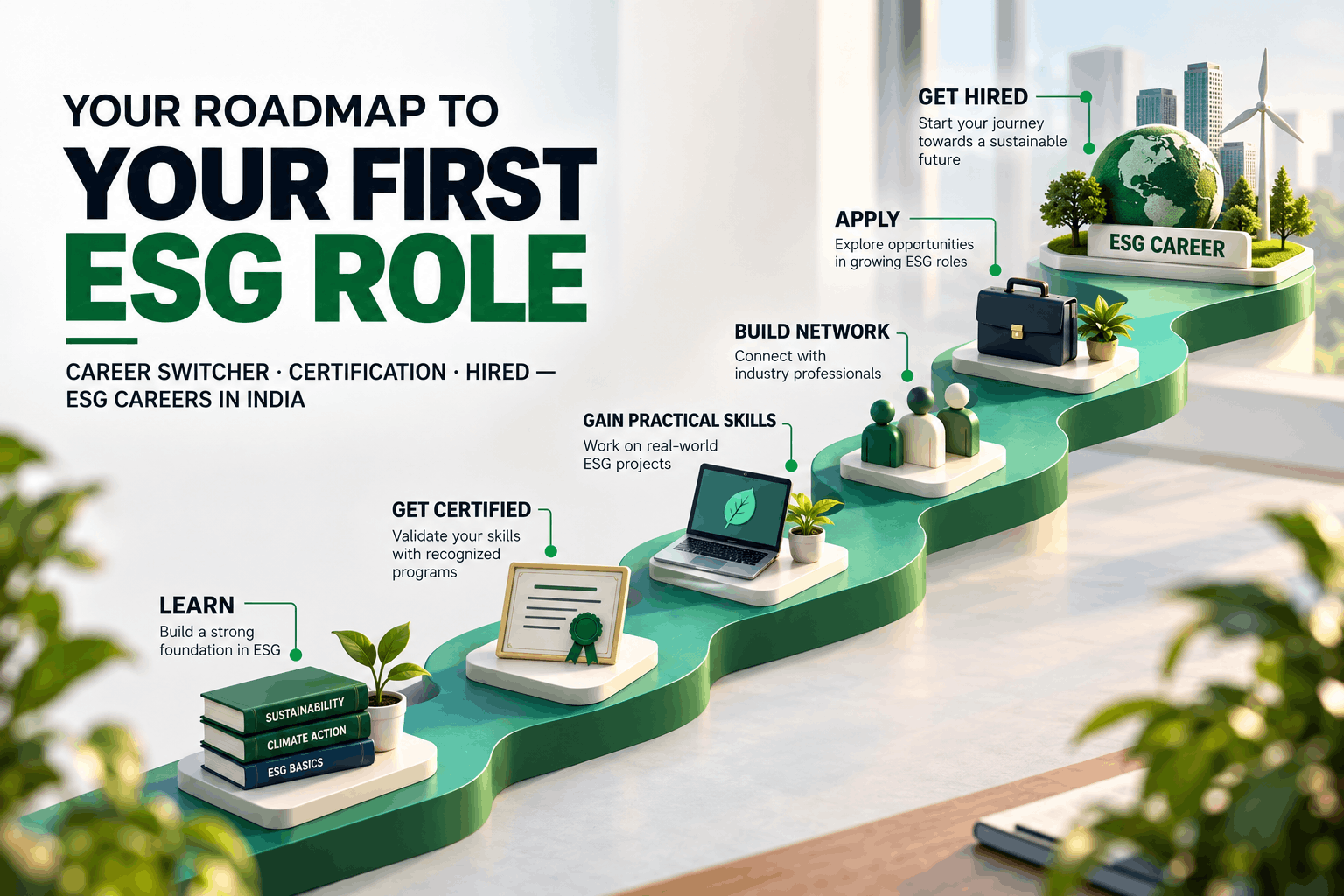
Hiring in ESG in India has increased after the BRSR regulation by SEBI
Sustainability course is not a must; finance, HR, operations can adapt easily
The most effective changes happen on the basis of an organized 4-6 month plan
Real disclosure experience carries much more weight than any certificate
It all begins with an e-mail that no one ever wished for. The board member will forward an e-mail about the SEBI BRSR requirements and will ask "can you do some research on this?" and boom! Someone from the financial, HR or compliance department will become their entire ESG department without having any kind of training or framework knowledge with a deadline too. If this is ringing a bell for you, then this is something that many Indians are only realizing now.
Here's the good news: you don't need to start from scratch, and you don't need a degree in environmental sciences either. You need a well-structured roadmap – the type that job seekers rarely receive because most of the information available online talks about ESG but doesn’t teach you how to become employable within it. This guide fixes that gap, and shows how eAsia Academy's ESG & Sustainability Reporting program maps onto every stage of it.
01The Big Reason Why There Is an Uptick of ESG Analyst Jobs in India
The sole driving factor here is regulatory, and that is the recent BRSR framework that has come into effect, requiring the top 1,000 companies on the market in India by market capitalization to have people who can collate the data and report. Combine that with pressure from international supply chain clients and investors, who expect their manufacturers, technology service companies, and banks and financial institutions to demonstrate ESG compliance and performance , not just policy.
The consequence is a gap in the job market that's appearing faster than new candidates are entering the fray, with companies that previously had no dedicated ESG staff two years ago forming full sustainability teams today, and usually hiring people from similar areas and upskilling them.
02The Actual Role of an ESG Analyst in Their Daily Work
Behind all the fancy talk about job titles, what an ESG analyst does on the day-to-day is rather down-to-earth and practical. In any given week, you could find yourself gathering environmental, social, and governance information from your HR, finance, procurement, and operations departments; aligning that information with reporting guidelines such as BRSR and GRI at many companies; writing parts of your company's annual sustainability report; measuring metrics such as energy consumption, waste, diversity, and governance against prior years' figures; and communicating with outside auditors.
"None of this requires a scientific background. It requires comfort with data, process discipline, and the ability to translate framework requirements into plain instructions other departments can follow."
03The Key Skills Needed Prior To Applying
When looking at ESG Analyst job listings for India, it doesn’t matter whether the employer is a bank, a manufacturer, or an IT services firm – the key skills remain fairly consistent:
- Framework expertise – at a minimum BRSR, with GRI being an even stronger asset
- Data and spreadsheet skills – proficiency in Excel is a must, while Power BI or similar are a definite plus
- Understanding of the basic ESG metrics – emissions, energy use, diversity of workforce, board structure, and supply chain management
- Communicating across functions – you will be spending more time requesting data from other departments rather than analyzing it on your own
- Basic understanding of regulations – know what SEBI and eventually the Ministry of Corporate Affairs expect
What do you notice missing from this list? It’s the sustainability degree, scientific background or several years of “ESG experience.” This is a skill set that can be learned, and that’s precisely why structured certification program has become the quickest way in.
Ready to Build These Skills the Structured Way?
eAsia Academy's Professional Certificate Program in ESG & Sustainability Reporting — delivered with IIT Roorkee academic partnership — is built around exactly this skill set, with hands-on disclosure drafting and real case studies.
04Your Step-by-Step Career Roadmap, Stage by Stage
Here's what a realistic, focused roadmap into an ESG Analyst role actually looks like when it's followed with intent rather than picked up piecemeal:
| Roadmap Stage | What You Focus On | Typical Timeline |
|---|---|---|
| 1. Foundations | Core ESG concepts, why frameworks exist, how Indian regulation works | Weeks 1–4 |
| 2. Framework Certification | Structured, in-depth learning of BRSR and GRI disclosure requirements | Weeks 4–12 |
| 3. Applied Project | Drafting a mock BRSR/GRI disclosure using a real or simulated company | Weeks 12–18 |
| 4. Job Search & Interviews | Targeted applications, framework-specific resume positioning, interview prep | Weeks 16–24 |
The professionals who move fastest through this roadmap aren't necessarily the most naturally "sustainability-minded" — they're the ones who treat stage 3, the applied project, as non-negotiable — because that's the piece that actually convinces a recruiter you can do the job, not just describe it.
05Common Blunders That Can Result in Rejection of ESG Applications
- Settling for a general awareness of ESG principles – a recruiter can discern the difference between mere awareness and framework proficiency within the first two interview questions
- Failing to have a portfolio item – a resume that mentions only the certification without any proof works less favourably than one with a disclosure included
- Neglecting your industry background – ESG concerns in the manufacturing sector vary significantly from those of IT services and BFSI
- Focusing merely on “ESG” and not on frameworks – resumes that state BRSR and GRI gain more attention than those mentioning "sustainability experience"
- Applying exclusively to jobs with the title "ESG Analyst" – there are several other job titles that require the same skills
06Steps to Acquire the Position of First-Time ESG Analyst
Having acquired the necessary skills and a project to prove them, one should employ some strategic approaches in searching for the job. These include looking out for organizations where there is an evident development of the sustainability department, changing one’s profile with the particular frameworks mentioned rather than the standard phrase "passionate about sustainability," and casting a broader net than just ESG Analyst.
4 Must-Have Skills in Every ESG Analyst Job Description:
Reporting Frameworks
Familiarity with the disclosure frameworks of BRSR and GRI
Data & Analytics Tools
Comfortable using Excel and, better still, Power BI or other reporting tools
Stakeholder Communication
Capability to source accurate data from financial and operational departments
Regulatory Knowledge
Understanding of SEBI and Ministry of Corporate Affairs guidelines
07How Does the eAsia Academy’s ESG Program Fit into This Roadmap?
The Professional Certificate Program in ESG & Sustainability Reporting offered by eAsia Academy along with the academic alliance of IIT Roorkee is strategically designed to take you step-by-step from the foundation stage all the way through these four roadmap phases rather than letting you figure out on your own how to sequence them. As the eAsia Academy is dedicated to a green future, the program is focused on current requirements of employers in India, such that by the end of the program you complete a roadmap on your CV.
08Explore eAsia Academy's Other Certification Programs
Many ESG professionals in India build adjacent expertise as their careers grow. eAsia Academy's other flagship programs, also backed by IIT Roorkee academic partnership:
FAQs
No. Most ESG Analysts in India come from finance, HR, operations or compliance backgrounds and learn framework knowledge through certification.
Compensation varies by city and industry, but generally sits above comparable general compliance or CSR roles due to the current talent shortage.
Most career switchers become job-ready in four to six months by following a structured roadmap of foundations, certification, an applied project and job search.
Self-study can build awareness, but recruiters increasingly screen for structured, demonstrable framework knowledge and a portfolio piece, which certification programs provide.
Listed manufacturing, BFSI, and export-oriented IT and services companies are currently the most active ESG hirers, largely driven by the SEBI BRSR mandate.
Yes — finance, HR, operations and compliance are common entry points, since those functions already generate much of the data ESG reporting depends on.
Yes — the program includes practical disclosure projects and career support to help learners move from certification into an actual ESG role.