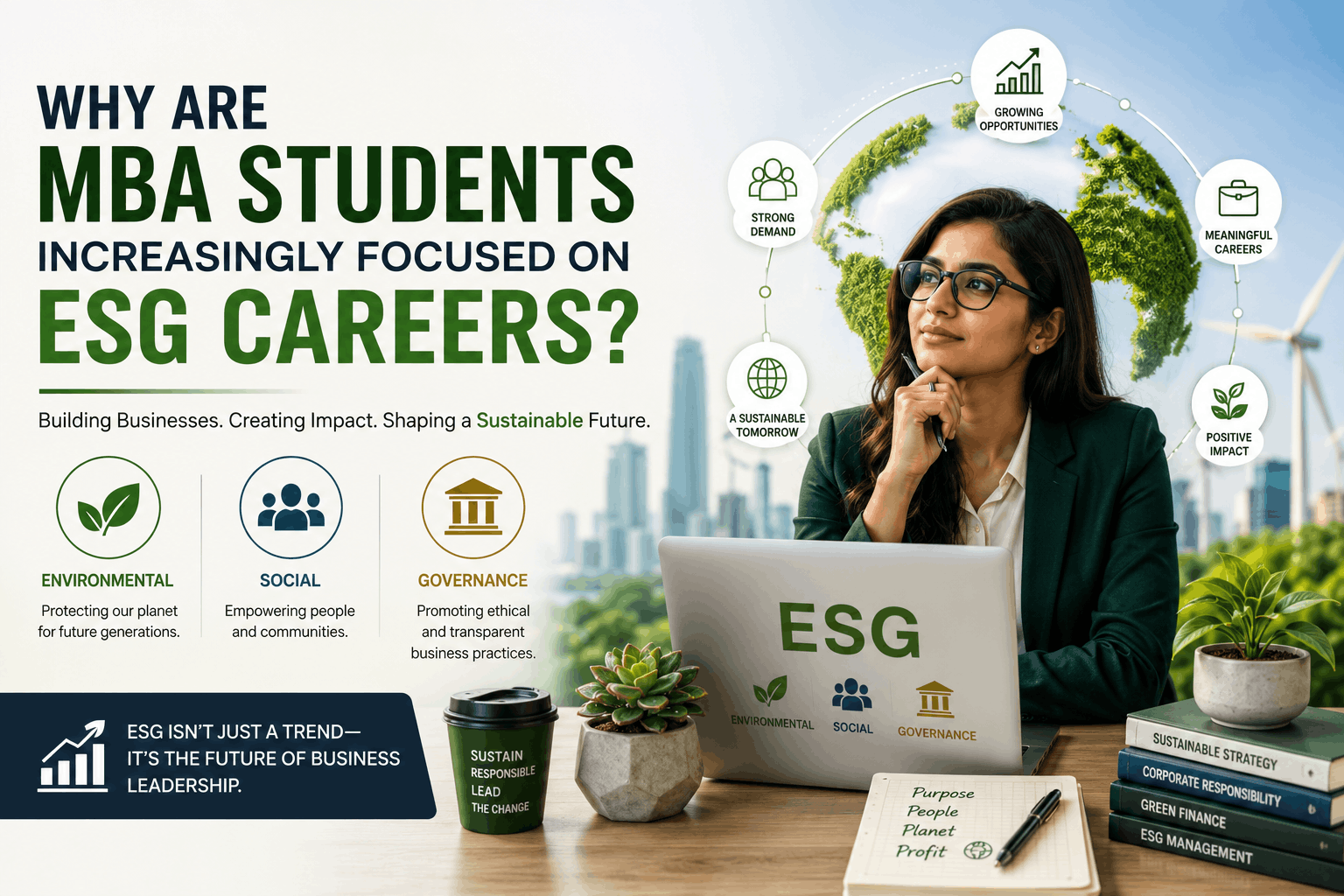
Why Are MBA Students Increasingly Focused on ESG Careers?
The realm of business is evolving swiftly. Nowadays, business organizations are not evaluated merely on their income, profit, and market share. Investors, customers, employees, government authorities, and numerous other stakeholders are increasingly interested in business operation methods.
This is the position ESG (Environmental, Social, and Governance) occupies in today’s business.
The shift is auspicious for MBA graduates. They have been accustomed to being prepared for jobs in finance, marketing, consulting, operations, and management. However, ESG has become a discipline at the crossroads between these areas.
Companies hire professionals skilled in both business strategy and sustainability. This is one of the reasons why ESG career opportunities for MBA graduates are in increasing demand.
What Is ESG? What does ESG mean?
ESG stands for the following:
E for Environmental aspect
The environmental aspect deals with the impact of a business on the environment. Areas of interest are noted as follows:
- Climate change and greenhouse gas emissions
- Renewable source of energy
- Energy efficiency
- Waste management
- Water conservation
- Carbon reduction practices
S for social aspect
Social aspects deal with the management of business relations with the people and society. The major fields that are taken into consideration:
- Employee welfare
- Diversity and inclusion
- Human rights
- Community activity
- Health and safety
- Supply chain responsibility
G for governance aspect
Governance means how the company is being run and governed. The following aspects of governance should be covered:
- Corporate ethics
- Board structure
- Transparency
- Risk management
- Regulation compliance
- Responsible decision-making
The importance of ESG is that MBA students are interested in the areas mentioned above as they are strongly connected with business strategy, business leadership, finance, risk management, business operations, and corporate governance.
1. ESG Is Becoming Integral to Business Operations
Sustainability has been regarded primarily as a separate corporate function in the past. Now, ESG is increasingly linked with key business activities.
Today’s companies are addressing ESG issues when making decisions about:
- Investments
- Business expansion
- Risk management
- Supply chain management
- Branding
- Corporate strategy
- Communicating with investors
Businesses will require professionals to integrate sustainability targets and commercial goals into their strategy.
This is where MBA graduates can benefit.
An MBA student is likely familiar with such topics as market strategy, financial evaluation, operational efficiency, leadership, and business growth.
Possessing knowledge of ESG issues, they can combine traditional management expertise and newfound sustainability knowledge.
This approach can provide MBA graduates with great career possibilities in the field of ESG.
2. Increasing Demand for ESG Specialists
The need for specialists with ESG expertise is growing in many industries.
Companies are developing sustainability plans, ESG disclosures, climate risk issues, responsible business operations, etc. Therefore, new vacancies appear in industries like:
- Banking and finance
- Consultation
- Manufacturing industry
- Energy sector
- IT sector
- Real estate sector
- FMCG sector
- Medical care sector
- Construction sector
- Investment and asset management sector
MBA graduates are appropriate candidates for these positions because ESG jobs require more than technical knowledge in sustainability. Companies need specialists who understand business models, profitability, strategy, risk, and decision-making.
The following job positions are possible:
- ESG specialist
- Sustainability consultant
- ESG consultant
- Corporate sustainability manager
- ESG reporting specialist
- Sustainable finance specialist
- ESG risk analyst
- Responsible investment analyst
- Sustainability strategy manager
- Climate change and ESG consultant
The increasing number of ESG jobs for MBA graduates makes this profession really attractive.
3. More Attention Is Paid to ESG by Investors
The investment sector is one of the main reasons that explain why ESG has become so important.
Investors assess companies not just according to their financial results but based on the criteria that help to predict their sustainability and risk in the foreseeable future.
For instance, investors might take the following criteria into account:
- Climate change risk
- Corporate governance
- Supply chain risks
- Regulatory risk
- Social controversies
- Resource management
This has increased the significance of ESG in the financial and investment decision-making process.
MBAs studying finance have wide choices of career opportunities in the area of:
- Sustainable finance
- ESG investments
- Responsible investments
- ESG risk assessment
- Corporate finance
- Investment analysis
The increased interest of both businesses and investors in long-term risks and opportunities creates a number of career opportunities for people who know finance and ESG.
4. MBA Students Want Careers with Purpose and Impact
Decisions concerning careers are no longer only based on salary and job title.
Nowadays, many graduates are interested in working on important issues. Climate change, social inequality, businesses' responsibility for their impact on the environment, and similar problems are pressing concerns.
Having a career in ESG allows individuals to not only participate in the business world but also contribute to solving important global issues.
For instance, an ESG specialist can help the company to:
- Reduce carbon dioxide emissions
- Optimize work policies
- Implement sustainable development plans
- Determine ESG-related issues
- Increase transparency
- Create responsible supply chains
So, the idea of combining a career with a positive impact makes this field appealing to many students.
5. ESG Creates Opportunities Across Different MBA Specializations
ESG is a major benefit for a number of MBA specializations.
MBA in Finance
Students in finance can study:
- Sustainable finance
- ESG investment analysis
- ESG risk assessment
- Responsible investing
- Green financing
MBA in Marketing
Marketing professionals can work on:
- Sustainable branding
- Responsible communication
- Consumer sustainability trends
- Brand reputation management
- ESG communication
MBA in Operations
Some opportunities may include:
- Sustainable supply chain management
- Automation of processes
- Sustainable procurement processes
- Waste management systems
- Responsible sourcing practices
MBA in HR
Students can concentrate on social aspects of ESG.
- Diversity and inclusion
- Employee wellbeing
- Human capital management and development
- Corporate social responsibility policies
- Social impact
MBA in Strategy and Consulting
Careers in strategy consulting will require skills in:
- ESG consulting
- Sustainability consulting
- Climate change strategy development
- ESG risk management
- Corporate sustainability strategy development
This interdisciplinary nature of ESG opens up numerous career options for MBA graduates interested in the sustainability field.
6. ESG Knowledge Can Strengthen Career Differentiation
The job market for MBA graduates is challenging. Many candidates will hold the same degree in finance, marketing, or even management.
The best way to stand out from others is to acquire specialized knowledge in ESG.
For instance, instead of calling yourself just an MBA in Finance, you may say you are an MBA in Finance with specialization in ESG and Sustainable Finance.
While a marketer may present themselves as someone who holds an MBA in Marketing with a specialization in Sustainability and ESG Communication.
This extra specialization will benefit professionals immensely in the changing business world where new roles are being created every day.
However, students should concentrate on gaining valuable experience rather than just putting ESG on their CV.
They should know the meaning of ESG frameworks, what sustainability strategy is, how to do ESG reporting, the essence of materiality and climate risks, and what corporate governance means as well.
7. ESG Regulations and Reporting Requirements Are Increasing
Businesses are now facing intensifying pressure from stakeholders to adopt sustainable practices.
As a result, companies may require the expertise of professionals proficient in:
- ESG reporting
- Sustainability disclosures
- Data collection
- Business risks
- Governance practices
- Stakeholder communication
Graduates from MBA programs can help corporations use ESG information to inform business strategy and decision-making.
Therefore, an ESG certification for MBA students can be advantageous for people who wish to gain knowledge in the field.
8. ESG Consulting Is Creating New Career Paths
Consultancy firms and advisory agencies are involving companies in sustainability and related ESG challenges more than ever.
Such businesses might require support with the following:
- Creating ESG strategies
- Pinpointing important ESG matters
- Evaluating sustainability results
- Enhancing ESG reporting
- Evaluating climate risks
- Formulating sustainability strategies
MBAs are already ideal for consulting positions owing to their diverse skill set in structured problem-solving, business analysis, presentations, and making strategic decisions.
If they build on ESG skills, students will be well-prepared for consulting opportunities in the ESG area.
Which Competences Do Students Need to Have to Build Career in the ESG Area?
Students who want to work in the ESG field should develop a combination of skills in the business field and sustainable development.
Important for MBA graduates working in the ESG field are the following skills:
1. ESG Basics
A student should know the principles of environmental, social, and governance issues and their economic significance.
2. Sustainability Strategy
A student should learn how companies implement sustainable development in their long-term business strategies.
3. ESG Reporting Knowledge
A student should get to know the major principles of ESG reporting processes and requirements for disclosure.
4. Data Analysis
These professionals use key performance indicators, emissions calculations, corporate indicators, and reporting data.
5. Financial Knowledge
Finance is an important part of sustainable finance, ESG investment, and risk management activities.
6. Risk Management
It is important to know how environmental, social, and governance aspects can lead to business risks in a company.
7. Communication Skills
Professionals in this field should be able to convey clear information about ESG strategy and performance to stakeholders.
In what ways can an ESG course benefit MBA students?
Although an MBA gives a solid grounding in the field of business management and prepares students for an entrepreneurial career, an ESG course will also impart valuable knowledge about sustainability and responsible business practices.
Through a structured program in ESG, students can get to know about the following:
- Basic concepts of ESG
- Sustainable corporate practices
- ESG planning
- Sustainability reporting
- Environmental and climate change issues
- Social responsibility
- Corporate governance
- Potential risks and opportunities in ESG
Notably, many MBA graduates and professionals can benefit greatly from studying ESG since this course will help them combine their business management knowledge with the requirements that modern organizations undertake today.
If people are keen on taking the course in ESG, at eAsia Academy they can find possible learning opportunities that the teaching institution has in store for its students.
Selecting the best ESG course involves looking at the curriculum, instructors, practical aspects, relevance of the education received, and the correspondence to personal career aspirations.
Is an ESG Career a Good Choice for MBA Students?
For MBA students interested in emerging business trends, sustainability, consulting, finance, strategy, or responsible leadership, ESG can offer a promising area for professional development.
The field is especially relevant for people who want to combine:
Business Knowledge + Sustainability Understanding + Strategic Thinking
ESG should not be viewed simply as a short-term trend. Environmental and social issues, corporate accountability, risk management, and stakeholder expectations are increasingly becoming part of how organizations operate.
As this transformation continues, professionals who can understand both business performance and ESG considerations may be well-positioned for a wide range of roles.
Conclusion
The current developments in the business world have made MBA students inclined towards careers related to ESG. These days, companies look for professionals who can ensure growth and at the same time be responsible, understand emerging risks, interact with stakeholders, and create value in the long run.
ESG opens up many paths for management professionals who can work in other fields such as finance, marketing, consulting, operations, as well as strategy.
MBA students have a great opportunity to gain knowledge about ESG and acquire the right skills. A combination of MBA experience with expertise in ESG will find application in rapidly changing positions that relate to sustainability, responsible business, sustainable finance, consulting, and corporate strategy.
If you want to learn more about this new and interesting field, consider selecting an ESG-related program that would meet your career goals and develop the important skills and knowledge needed in your future profession.
Are you interested in pursuing a career in the ESG field? Visit eAsia Academy to choose the best ESG Program for you and take the first step toward a successful career in ESG.
FAQs
There is rising interest among MBA students in ESG careers because ESG is gaining significance as part of company strategies, finance, risk management, consulting, and corporate policymaking. Besides, ESG paves the way for applying managerial skills while utilizing knowledge about sustainability.
MBA graduates may opt for the positions of ESG Analyst, Sustainability Consultant, ESG Consultant, Corporate Sustainability Manager, ESG Risk Analyst, Sustainable Finance Expert, Responsible Investment Analyst, and Sustainability Strategy Manager.
Many MBA graduates possess the necessary skills and expertise to work in ESG. In particular, the insights they have gained in management with regards to ESG and sustainability can be of great help in various fields, such as finance, consulting, operations, marketing, and strategy.
As a new and growing phenomenon, ESG is becoming increasingly popular in the country among companies, investors, regulators, and other parties involved. This area provides budding professionals with a wealth of jobs in corporate sustainability, consulting, and finance.
There is no single specialization that could be singled out as the best. For example, finance specialization might be very relevant for implementing sustainable finance and ESG investing practices, whereas a specialization in strategy and consulting could help students land jobs in the field of ESG advisory.