AI in Recruitment: How HR Teams Are Cutting Time-to-Hire in Half
A period of 42 days for filling one position used to be normal. Here is how predictive screening and AI-based hiring analytics have made this possible without compromising hiring quality.
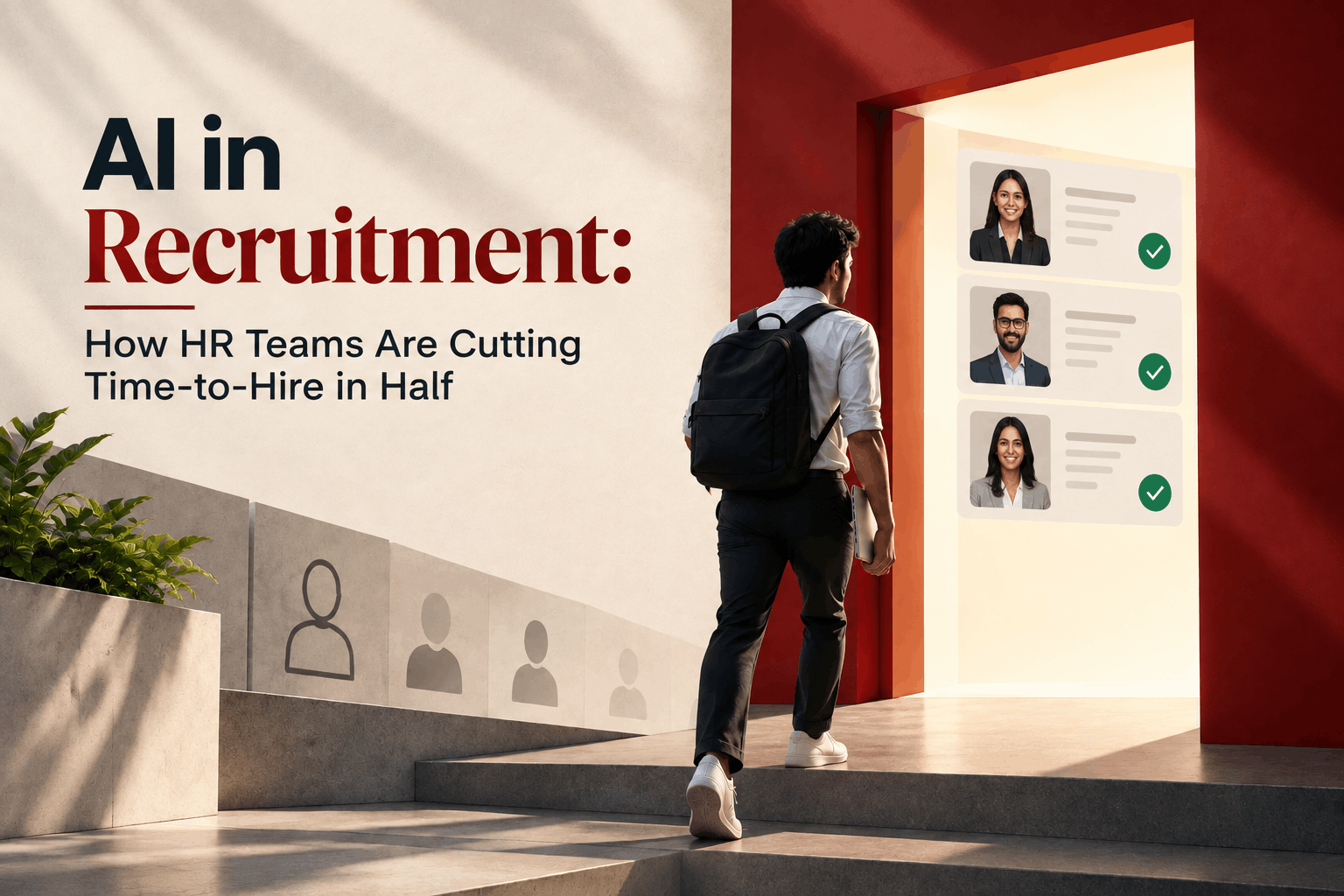
AI can reduce time-to-hire by 40-50%
Predictive scoring is better than keyword matching
Bias audit is a must-have
Human judgment always makes the final hiring decision
Ask any Talent Acquisition head in India why he/she cannot sleep peacefully, and most probably “Time-to-Hire” will be his/her answer. A role is kept vacant for six weeks, the hiring manager loses patience, and the top talent finds other places to work.
What changes all this is AI-enabled recruiting analytics — software that doesn't merely collect resumes but actively screens, ranks, and matches candidates based on predictive algorithms. And here's how that really works.
01The Source of Delays in the Traditional Hiring Process
Before blaming AI for being needed to fix the process, it makes sense to identify the true source of those delays:
- Manually screening resumes — spending hours going through hundreds of applications for one position
- Unsystematic candidate selection criteria — each recruiter having his/her own way of evaluating applicants without a unified scoring system
- Delays in setting up interviews due to emails exchanges and calendar coordination
- Late feedback from hiring managers — good candidates cooling off as their applications are still pending in someone's inbox
Almost none of these issues stem from lack of suitable applicants. They're pure process-related bottlenecks — exactly where AI systems excel.
02How Predictive Screening Actually Works
Rather than comparing keywords in the candidate’s CV to the job description, the prediction models are trained on historical data about the company’s own recruitment process, including who applied, who was selected, and how the selection performed within 6-12 months of hire.
“The recruiter is no longer reading through 300 resumes but looking at 25 pre-ranked candidates – and saving time for judgment.”
The recruiter’s actual job becomes that of culture fit and closing the deal, not sifting through piles of applications.
03The issue of bias that no one can afford to ignore
Prediction models will be as good as the data used to build them. Should the historical data that was used to hire contain any form of discrimination, say women being underrepresented in technical positions, the algorithm may simply reinforce the trend, unless it is audited. The use of AI models should therefore always entail an audit of shortlists based on gender, age, and educational background.
Ready to Own AI-Driven Hiring in Your Organisation?
Build predictive recruitment analytics, screening audits, and workforce AI skills with eAsia Academy's IIT Roorkee-backed program.
04Conventional recruiting vs artificial intelligence-driven recruiting
Here's how the two approaches actually stack up across the metrics that matter most to talent acquisition teams:
| What You Get | Traditional Recruitment | AI-Powered Recruitment |
|---|---|---|
| Resume screening | Manual review, hours per role | Automated scoring in minutes |
| Candidate ranking | Recruiter judgment, inconsistent | Standardised predictive match score |
| Average time-to-hire | 35-45 days for mid-level roles | 15-22 days for mid-level roles |
| Interview scheduling | Manual email coordination | Automated calendar matching |
| Quality-of-hire tracking | Rarely measured post-hire | Tracked against model predictions |
05Where this is currently taking place in India
Such systems were adopted by high-volume recruiters first as they could not cope with manual screening. Now it is rapidly moving to mid-size recruitment of white-collar workers.
IT Services
Recruitment of high-volume freshers through automated screening
BFSI
Predictive matching for relationship managers and salesmen
D2C & Retail
Recruitment of staff quickly during high seasons
Mid-Size Companies
AI screening for white-collar jobs due to increased speed being a differentiator
06The soft skill required in AI recruitment
The use of AI in recruiting does not make human judgment unnecessary; it just transfers it. There is always a person who will have to configure the algorithm with the proper evaluation criteria, audit the shortlists for discrimination, interpret match scores, and combine the AI output with structured interviews for the final decision.
And that is precisely why there is such a difference between people who just “use a tool” and those who really own and develop the recruiting analytics system.
07Develop the skill with eAsia Academy
Professional Certificate in Human Resource Management & Analytics Using AI — offered in partnership with IIT Roorkee in the academic space, this course features experiential learning on predictive recruitment analytics, attrition modelling, and AI-enabled workforce planning tailored for practitioners in human resource management, not engineers.
This is part of the set of flagship programs at eAsia Academy including ESG & Sustainability Reporting, and Carbon Credits, Carbon Markets & Net Zero Pathways, all following the same formula: relevant curriculum, practicing faculty, and project deliverables.
FAQs
AI saves time when hiring by streamlining the process through resume screening, rating candidates based on predictive matching scores, and eliminating the need for manual interview scheduling – saving as much as 40-50% in total time spent.
Yes, AI screening can be a source of discrimination during hiring, especially if the model is built based on the data from previous hiring that was discriminatory.
Predictive candidate matching refers to the ability to evaluate how a potential hire will fit the position compared to those who were successful in their positions in the past.
IT services organizations, BFSI organizations, and volume recruitment companies in retail and direct-to-consumer recruitments leverage AI technology for recruiting purposes.
Yes. These tools are mostly no code tools. The only thing required is the analytical capability to interpret results and make decisions.
Some of the common tools used are AI enabled applicant tracking system (ATS), such as Darwin box, iCIMS, Greenhouse, resume parsing tool, and Power BI for time and funnel analysis.
Professional Certificate in HR Management & Analytics Using AI with academic affiliation from IIT Roorkee has practical modules on recruitment analytics.