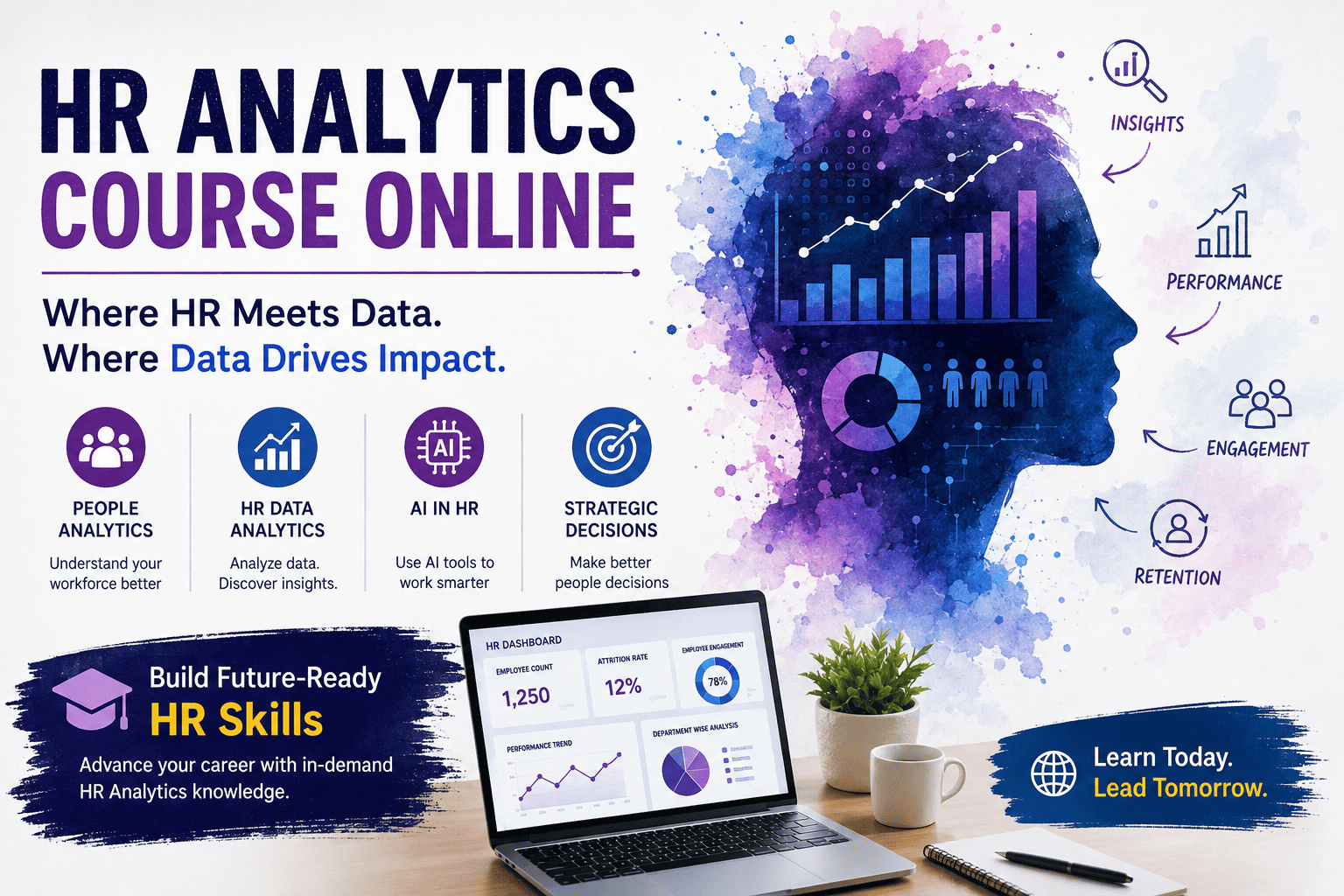
Why an HR Analytics Course Online Is the Smart Choice for Future HR Professionals
Human resources has evolved a lot in the last several decades. In the past, HR mainly dealt with recruitment, payroll processes, attendance, and employee administration. These functions are still part of HR's job, but companies now demand HR to be involved in more complex processes.
Today, companies want to know more about their employees. They want to understand what makes employees leave, which method of recruiting proves to be successful, what skills employees have, how motivation impacts the results of the employees’ work, and how decisions regarding the workforce can benefit the development of a company.
This is the moment when HR analytics comes into play.
An online course in HR analytics can help HR professionals understand how analytics may be used in the human resources field. If HR specialists combine their knowledge of HR with analytics, they will achieve powerful results in their work.
What Is HR Analytics?
Human Resources Analytics, meaning People Analytics, refers to the process of data collection, analysis, and HR-related data interpretation, which leads to useful information.
The goal isn’t only about making statistics and creating reports. HR analytics gives additional knowledge about behavioral patterns regarding data findings.
For instance, HR can analyze many types of data including:
- Employee turnover
- Recruitment success
- Time-to-hire
- Cost per hire
- Employee satisfaction
- Absenteeism
- Trends of performance
- Training and development
- Workforce planning
Why Are HR Analytics Skills Important for Future HR Professionals?
Organizations are becoming increasingly reliant on data. The HR departments are also changing to become more strategic and tech-enabled.
Today, HR professionals are expected to interact with multiple stakeholders, recognize the challenges related to workforce issues, and assist the achievement of business objectives. Analytics can offer relevant evidence for these tasks.
Here are some reasons why HR analytics skills are important.
1. Better Data-Driven Decision Making
Traditionally, HR decisions could be based mainly on experience and intuition. Even though experience is still important, data provides another point of view.
For instance, instead of making an assumption on why employees are quitting, HR personnel can analyze the data and find the patterns. This will allow companies to learn about problems faster and make right decisions.
Studying through an HR analytics online course allows you to learn how to properly analyze HR data.
2. The Role of HR is Changing
HR is transitioning from a mostly administrative function to a more strategic role.
Many companies expect HR departments to provide contributions regarding talent and workforce issues and be able to assess employee capabilities and determine the needs of their organizations.
As a result, people with knowledge of human resources and HR analytics will be more suitable for these discussions about the strategic direction of the company.
3. Growing Importance of People Analytics
People Analytics is an essential field of modern HR. It uses data to analyze information regarding the workforce and thus provides insight into employees and the organization.
People Analytics can assist in:
- Talent acquisition
- Retention strategies
- Workforce planning
- Employee engagement
- L&D
- Performance management
- Skills gap analysis
With a larger amount of workforce-related data available, it becomes more important to analyze it and get useful insights.
How Is AI Changing the Future of HR?
The impact of artificial intelligence on professional life is significant in any professional area, including Human Resources.
Using AI-based tools will enable HR professionals to process information, recognize patterns, create reports, make summaries, and make workflows more efficient.
AI can help in HR with:
- Preparation of significant amount of information.
- Facilitation of data analysis process.
- Recognition of different patterns.
- Improvement of reporting process.
- Assistance in workforce planning.
- Facilitation of HR communication process.
- Support for skills analysis.
Nevertheless, humans and their judgment should not be replaced by artificial intelligence.
In this regard, it is important to take some crucial issues into account.
These issues include the personal data protection, fairness, discrimination, openness, and involvement of people in the process.
That is why future HR professionals need to learn more than just the principles of AI use in their profession.
What Skills You Can Acquire from an Online HR Analytics Program?
While each institution has its own curriculum, there are few important skills that can be acquired through an HR analytics course.
HR Metrics Interpretation
HR professionals may need to work with various metrics that represent different processes and outcomes. Thus, the ability to apply HR metrics should be developed as a part of HR analytics training.
Examples include recruitment metrics, employee retention metrics, performance metrics, and learning metrics.
HR Data Analysis
HR professionals should gather the data, however, being able to read and interpret this data is also important.
HR analytics course can help learners develop analytical skills required to find various trends in the data.
People Analytics
Students will learn how workforce data can be used to identify various trends and identify people-related solutions.
Reporting
HR professionals should be skilled in reporting insights to managers.
Reporting is more than presenting numbers.
Why Opt for an Online HR Analytics Course?
One major benefit of online education is adaptability.
The Online HR Analytics Course may benefit:
- Current HR employees
- Recent college graduates
- Recruiters
- HR supervisors
- Professionals switching careers
- People working in the corporate sector
With online education, professionals are able to acquire new competencies while simultaneously juggling their jobs, studies, or other obligations.
Moreover, it allows students to explore such current issues as HR Analytics, People Analytics, Data-Driven Decision Making, and Artificial Intelligence in HR.
Jobs Available to Those Who Understand HR Analytics
Gaining knowledge of HR analytics can help someone own an HR-related job.
Available positions would include:
HR Analyst
An HR analyst works with data and reports in HR to evaluate trends in the workforce.
People Analytics Analyst
This type of role seeks to analyze employee and organizational performance data.
Recruitment or Talent Analytics jobs
These professionals analyze recruitment data and information on candidates, evaluation of recruitment effectiveness, and talent acquisition metrics.
Workforce Analyst
The role of the Workforce Analyst consists mainly of supporting workforce planning and analyzing employee-related data.
HR business jobs
Knowledge of analytics is useful for those who work in business process jobs such as HR Operations and others.
An Online HR Analytics Course is helpful for individuals at various points in their career.
HR Professionals
This training can improve your knowledge of modern data-driven approaches to the management of human resources.
Recent Graduates
If you are a graduate looking for a starting job in HR, learning about analytics can be a good help for you.
Recruiters
The knowledge of hiring metrics, candidate data, and recruitment performance will benefit you as a recruiter.
Business Professionals and Managers
Managers overseeing a team get the chance to understand the workforce's data and people insights they have.
Career Changers
People wishing to change careers to HR can learn HR analytics along with basic HR knowledge.
The Role of HR Analytics in the Future of Work
Professionals will be required to adapt to ever-evolving technology and business requirements in the future workplace.
HR will always be in need of key human skills like good communication, empathy, ability to establish relationships, and ethical judgment. At the same time, the new future professional will also be expected to use data with technology.
The future HR professional may need to combine the following:
Understanding Human Being + HR Knowledge + Data Skills + Technology Awareness
The right balance of all four elements will help people address problems of labor force and make more significant inputs into the achievement of business objectives.
Build Future-Ready HR Skills with eAsia Academy
The program on Human Resource Management and Analytics using AI at eAsia AcademyeAsia Academy is for professionals who want to upgrade their knowledge of modern HR. This course is aimed at making participants know the evolving role of human resource management and the growing significance of data-driven decision-making.
With the help of this learning experience, participants will acquire knowledge of HR Analytics, People Analytics, HR Data Analytics, and AI in HR which will help them build a sound basis for the future of HR.
Thus, this course can become a smart choice for those who want to advance in their HR careers.
FAQs
An online HR analytics education provides students with knowledge about how human resource (HR) and workforce data is analyzed for determining trends, grasping metrics, and making proper data-driven HR decisions.
The common audience for HR analytics education includes HR specialists, graduates, recruitment staff, management staff, and anyone else interested in HR.
Depending on a program of complexity, learners are capable of getting knowledge in HR metrics, data interpretation, people analytics, analytics thinking, and several technologies related to AI in HR.
Those terms are similar. While HR Analytics mainly focuses on HR information, People Analytics can be considered a wider aspect of analyzing workforce processes.
Indeed. Even though it is a highly valuable capability in HR management since, nowadays, it becomes harder to do without workforce data.