Understanding Carbon Credits and Their Role in Climate Action
Carbon credits are very important parameters in combating climate change and cuts in greenhouse gases emissions. Amid growing attention of businesses, governments, and organizations on sustainability, carbon management, and climate action, the understanding of carbon credits is increasingly important.
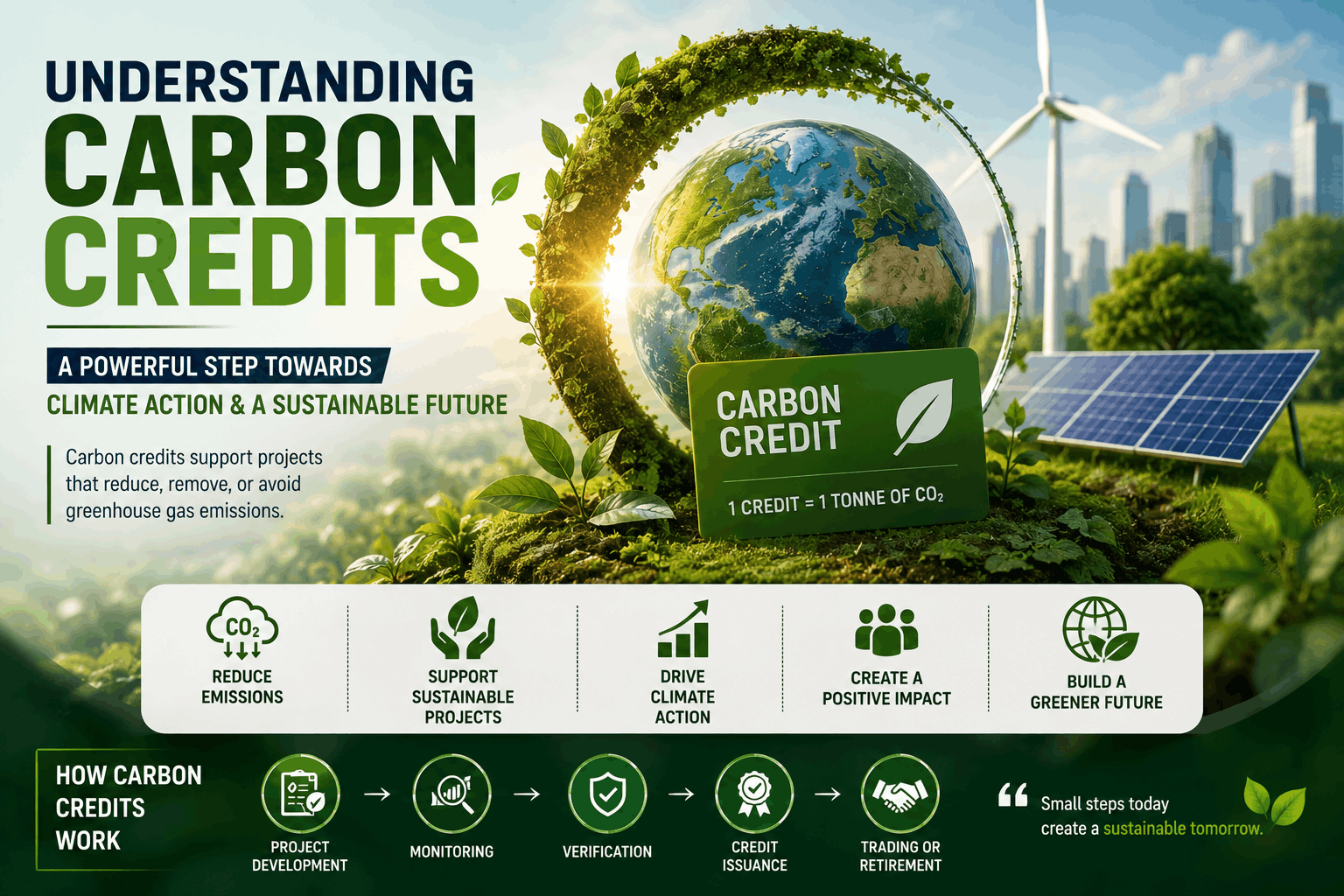
In general terms, a carbon credit denotes a metric ton of carbon dioxide equivalents (CO₂) reduced, avoided or sequestered through an eligible project/activity. Carbon credits can be either traded or retired based on applicable carbon market, standard or registry regulations.
What Are Carbon Credits?
Carbon credits have been created to assign an economic value to certain reductions or removals of greenhouse gases from the atmosphere. Carbon credits can be issued on the basis of certain projects that lead to emissions reduction in comparison to a relevant baseline or carbon removal from the atmosphere.
Carbon credit project examples could be renewables, energy efficiency projects, afforestation, reforestation, methane capture and waste management.
The credibility and quality of carbon credit depend on several factors that are related to the methodology, project eligibility, monitoring, reporting, verification and applicable carbon standard.
How Do Carbon Credits Work?
It is customary for the carbon credit process to begin with the realization of a viable emission reduction or an opportunistic carbon removal project. The project is crafted and evaluated as per the specified guidelines and methods. After the commissioning of the project, it is monitored for all environmental results obtained.
Based on the framework, there might also be a requirement to go through a process of independent verification to receive the applicable carbon credits.
The process looks as follows:
Project establishment → Monitoring → Verification → Issuing of credit → Trading
Having received the credits, they may be sold on the market or retired.
Different Varieties of Carbon Credit Projects.
Various types of projects might lead to the generation of carbon credits.
Renewable Energy: Solar and wind power projects can help lessen reliance on energy options with higher emissions.
Forestry and Land Use: Projects related to reforestation or afforestation can enable the removal of carbon dioxide from the atmosphere while providing additional ecological advantages.
Energy Efficiency: Various projects aimed at enhancing energy efficiency help cut down on energy demand, which results in fewer greenhouse gases being emitted into the atmosphere.
Methane Capture: Besides, methane can be harvested from certain sources like landfills, thus minimizing a powerful greenhouse gas emissions.
Waste Management: Besides, waste management, recycling, and some projects of waste-to-energy generation can enable the reduction of emissions if they comply with certain criteria.
What is the Importance of Carbon Credits?
Carbon credits have the potential to direct monetary flows to climate-related projects and initiatives and, thus, they can assist in creating carbon markets through an economic mechanism involving measurable emission reductions or removals.
For companies, understanding carbon credits may be useful in making better sustainability and carbon management decisions. Companies may want to learn more about their “footprint”, discover opportunities for emissions reductions, and see how carbon markets work in the context of their action.
However, carbon credits should not be seen as an alternative to cutting down one’s own emissions.
Carbon Credits and Carbon Markets
Carbon credits are linked to carbon markets that offer opportunities for people to issue, trade, buy, and retire carbon-related products.
There are two main types of carbon markets discussed: compliance carbon markets and voluntary carbon markets.
Compliance markets function through regulatory regimes, and organizations participating in such markets may have to fulfill different obligations. In voluntary markets, entities or other parties engage in the process of purchasing and retiring carbon credits voluntarily for climate-related causes following the rules and claims that govern the respective area.
The knowledge of the specifics of these markets is essential for representatives of various organizations and professionals in the field of sustainability, ESG, environmental management, and finance or climate-related areas.
Carbon Credits and Businesses
Firms are stressing the significance of carbon footprints more these days due to the impact of climate issues on operational costs, compliance requirements, supply chain management, funding opportunities, and long-term corporate strategies. Thus, when comprehending carbon accounting and carbon reduction, carbon markets and credits, a person can assess climate risks and opportunities.
First, companies can calculate their greenhouse gas emissions, determine major polluting activities, define required reduction goals, etc.
Carbon Credits in India
As part of its broader climate and energy transition endeavors, India has started working on establishing its carbon market framework. Potential for renewable energy, industrial operations, and sustainability concerns are leading to a rise in interest in carbon markets in India.
Various professionals, including those involved in ESG, sustainability, environmental management, energy, consulting, finance, and corporate strategy, must learn about carbon credits and the growing carbon market.
The fate of carbon markets in India will hinge on regulatory structures, market standards, project quality, monitoring, and verification systems, as well as the involvement of companies and other stakeholders.
Learn More About Carbon Credits
As the carbon markets keep on changing, people who work in the field can enhance their knowledge of carbon credits, carbon markets, carbon management, greenhouse gas emissions, and combating climate change.
eAsia Academy provides training and programs that help in learning about carbon credits, climate action, and topics of importance in the sustainability area.
Conclusion
Carbon credits play a significant role in the changing environment of climate and sustainability. They can back projects that aim to reduce emissions. Carbon credits help make the measurement and trade of carbon-back-based units possible.
Carbon credit projects can pertain to a wide variety of activities that range from renewable energy and energy efficiency to forestry and methane capture projects. With businesses and governments being directed toward climate issues, it will be increasingly necessary for sustainability professionals and organizations to know about carbon credits and carbon market-related issues.
Acquiring knowledge in this field will allow professionals to learn more about the current opportunities, difficulties, and market tools which accompany the transition towards the low-emission economy.
FAQs
In general, carbon credits refer to the emissions reduction equivalent to one ton or 1 metric ton of CO₂ achieved through activities or projects that adhere to specific conditions.
The carbon credits generation originates in a variety of activities including renewable technologies, energy efficiency, forestry practices and methane capture, and other emission mitigation or removal processes.
The carbon market functions as a system that allows trade of carbon-related units in accordance with certain rules.
Indeed, gaining knowledge of carbon credits may allow businesses to learn about carbon management while developing climate strategies and sustainability concepts.
The future will depend on the existing regulatory framework in India, as well as its market dynamics, project credibility, verification, and engagement of businesses in carbon-related activities.