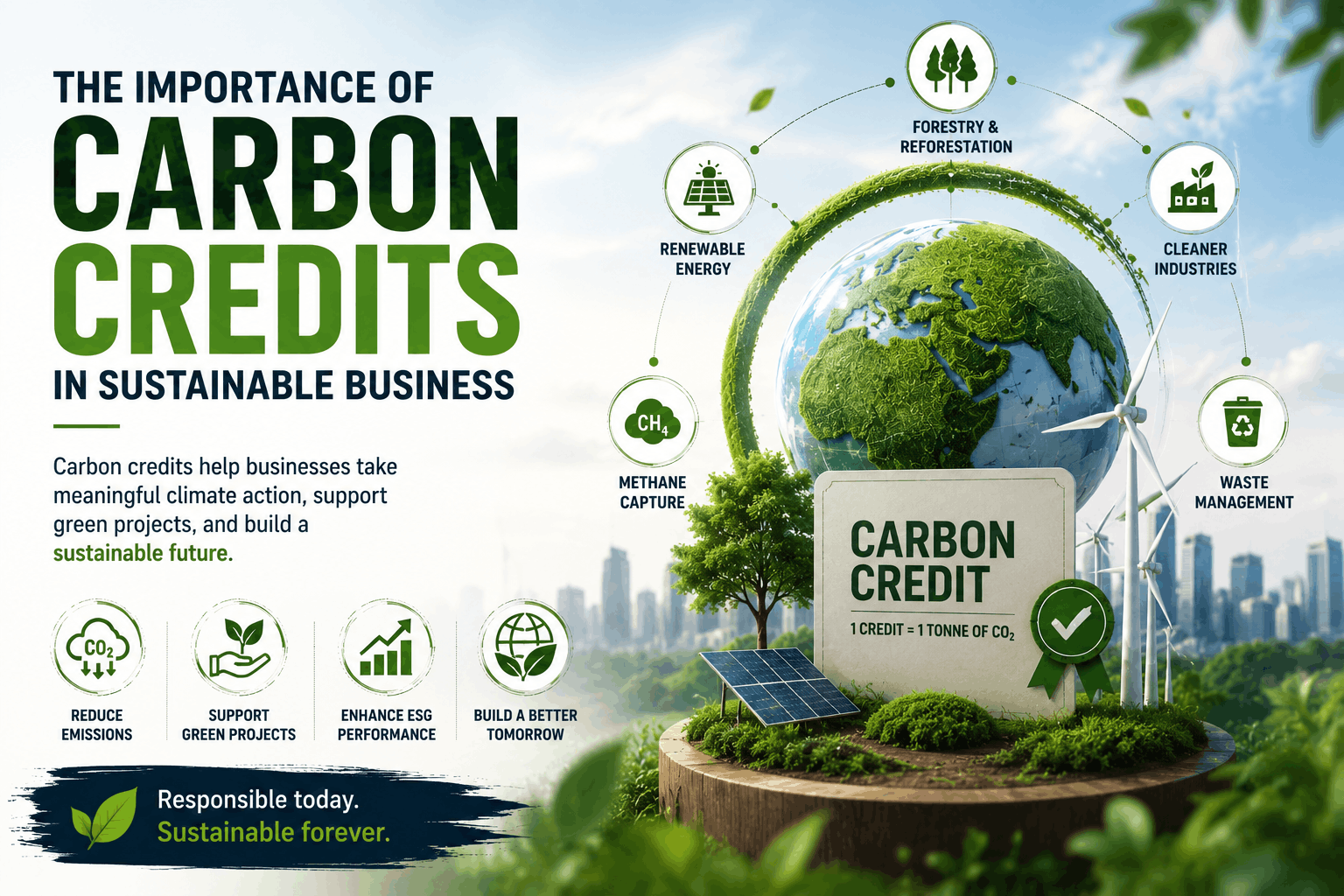
The Importance of Carbon Credits in Sustainable Business
Sustainability is becoming more significant for today’s companies. All sectors care about such things as greenhouse gases, climate change risks, efficiency, and ethical business practices. As companies try to minimize the negative impact on the environment, carbon credits have become an important instrument in the larger carbon market and climate action arena.
For companies, it is not enough to grasp carbon credits solely in terms of emissions. Organizations need to understand carbon management and climate strategies. However, carbon credits should be used within a wider framework in which measuring and reduction of emissions at their source has the priority.
What Are Carbon Credits?
A carbon credit is defined as a tradeable asset that reflects the reduction, evasion, or elimination of one metric ton of CO2 (carbon dioxide) through a project or activity recognized as a credible approach in that field.
Carbon credits can be accredited to several different projects, such as renewable energy, methane recovery, energy conservation, afforestation or reforestation, as well as a few waste management projects. Projects that produce carbon credits may have to go through different monitoring and verification processes, depending on which standard or market they comply with.
It is possible for businesses to have to acquire and utilize carbon credits that comply with a certain standard and regulatory framework.
Why Are Carbon Credits Important for Businesses?
Businesses emit greenhouse gases through processes like energy use, transport, manufacturing, logistics and supply chains. The measurement and reduction of these emissions have become key components in sustainability management.
Carbon credits add another avenue for companies to invest in emission reduction and removal activities, especially in cases where emission reduction cannot be achieved immediately.
However, companies must not view carbon credits as substitutes for actual emissions reduction initiatives. A good sustainability approach must include measuring emissions, identifying the sources, enhancing efficiency, and cutting emissions where possible.
Carbon Credits and Sustainable Business Strategy
A sustainable business strategy takes into account both ecological performance and long-term sustainability. Carbon management is one component of this strategy because it allows companies to understand the sources of their emissions and areas of improvement.
A stepwise process can be followed:
Assess → Reduce → Manage → Fund?
The first step involves assessing the greenhouse gas emissions of a company. Once emissions have been assessed, a company will be able to identify the areas for increasing its energy efficiency, implementing renewable energy sources, improving operations, and changing processes.
Carbon credits will then be taken into account in respect of the respective climate strategy, as far as there are standards and claims which need to be satisfied.
Supporting Renewable Energy and Environmental Projects
Carbon markets have an important function because financial investments can be directed at projects in the environmental field.
For instance, carbon finance may fund projects related to solar energy, wind energy, energy efficiency, forest restoration, methane capture, and waste management.
When projects meet the requirements established by the methodologies and standards, they can contribute to emission reductions or removals.
By participating in carbon markets responsibly, companies will better understand the soil process of climate finance that connects environmental projects to economic aspects.
Carbon Credits and Corporate Sustainability
The term "corporate sustainability" cannot be understood in only dealing with environmental departments. Today, it also extends to leadership, finance, operations, procurement, supply chain, risk management, and human resources.
Carbon management becomes an integral part of the overall corporate sustainability planning process.
Companies can use carbon information in a number of tasks, such as:
- Developing sustainability strategies
- Setting climate-related goals
- Implementing emission reduction measures
- Creating environmental reports
- Launching supply chain initiatives
- Developing risk management frameworks
- Establishing ESG programs
Thus, understanding carbon credits can help professionals in various areas to communicate more effectively in relation to climate-related issues, opportunities, and risks.
Carbon Credits and ESG
Carbon management relates to the environmental component of ESG. Environmental performance can encompass areas such as greenhouse gas emissions, energy consumption, climate risks, disposal practices, water use, and resource management.
Firms working on ESG initiatives may need to understand the following concepts:
Carbon footprint: greenhouse gases emitted by a company, activity, product, or service.
Carbon reduction: actions taken to reduce greenhouse gas emissions.
Carbon removal: actions that remove CO2 from the atmosphere.
Carbon credits: units that show how much emissions, removals, or avoidance has been achieved according to rules and regulations.
Knowing these terms can help firms build better and more aware sustainability strategies.
The Role of Carbon Markets
Various forms of carbon markets are used for carbon credits. Two of the more significant markets are compliance carbon markets and voluntary carbon markets. Compliance markets are based on legislation requiring companies to adhere to specific emissions restrictions or carbon limits. On the other hand, voluntary carbon markets involve companies buying or retiring carbon credits without being mandated by legislation. With the continuous evolution of the carbon market, it is crucial for businesses to assess the quality of projects, verification, transparency, methodology, and reliability of environmental claims before using or acquiring carbon credits.
Carbon Credits in India
As part of its broader climate and energy transition efforts, India is developing its carbon market framework. In addition, the rapid growth of the Indian renewable energy sector, the industrial base, and sustainability priorities makes it easier for carbon credits and carbon markets to develop in India.
Indian firms are, therefore, becoming more interested in carbon accounting, ESG compliance, sustainability reporting, energy efficiency measures, and climate strategies.
With the development of this carbon market in India, the skills related to carbon management, carbon market knowledge, carbon accounting, ESG, and sustainability may become crucial across different sectors.
Benefits of Understanding Carbon Credits
Carbon credits know-how is a great asset for companies and professionals alike. This knowledge helps the organizations comprehend the very basics of the carbon market as well as understand how to use climate-related mechanisms in their sustainability strategies.
The other important thing is that carbon knowledge allows a professional to understand carbon measurement and greenhouse gas emissions, approaches to climate finance, and the practice of carbon trading.
Equally important, carbon credits understanding allows for better decision-making: it enables companies to evaluate better their environmental activities rather than viewing carbon credits simply as a commodity.
Challenges Businesses Should Consider
Carbon credits come with possibilities, as well as with potential difficulties.
Not all carbon credit schemes yield comparable environmental benefit. The great many variables–additionality, permanence, measurement, monitoring, reporting, verification and leakage, etc.–that go into determining the legitimacy of a credit are what ultimately determine the notion of “legitimacy” and a particular credit being worth while.
Organizations must therefore apply proper standards, registries, or methodologies before using the credits.
How Businesses Can Get Started
Companies that are engaged in carbon management can adopt a practical method.
The process consists of determining and analyzing greenhouse gas emissions. This can be done by identifying major sources of emissions and looking for ways of directly reducing them. Organizations will focus on setting sustainability goals and exploring carbon market options.
Professionals have to keep abreast of changes in legislation, carbon market regulations, validation conditions, and corporate climate commitment.
Those who want to acquire fundamental knowledge in this sphere can benefit from formal learning. For instance, eAsia Academy offers courses that cover topics like Carbon Credits, ESG, Sustainability, and environmental management.
The Future of Carbon Credits in Sustainable Business
As firms strive to tackle climate-related risks and ensure sustainability, carbon management remains a key aspect in the realm of corporate strategy. Carbon markets will likely continue their evolution as a result of progress made in the area of climate regulation, standards, technology, and corporations' climate commitments.
Carbon credits will depend heavily on the quality and credibility of the projects, transparency of the market mechanisms, and strong monitoring and verification, and the responsible behavior of businesses.
Simply purchasing the carbon credits is not the objective for the businesses; they have an option to create a comprehensive climate strategy to achieve emission measurement, reduction, renewable energy, operational efficiency, and responsible supply chains using carbon-market mechanisms.
Conclusion
Carbon credits can be very useful in the changing scenario of sustainability. They can promote the execution of different projects for the climate and become a new way for companies to manage emissions within the framework of wider climate strategies.
When sustainability is entering more and more into business decisions, being aware of carbon credits, carbon markets, carbon management, and ESG will help companies make more reasonable decisions.
Companies that implement a combination of direct emissions reduction and responsible participation in carbon markets will be more ready for the economy that is becoming more aware of climate issues.
FAQs
With carbon credits, businesses will be able to help in funding projects that reduce emissions or remove particles from emissions.
Carbon credits can aid companies in financing projects aiming at improving climate conditions as well as understanding and tackling their performance in terms of greenhouse gas emissions.
No, proper emission reduction will always play a crucial role in a proper climate strategy. The use of carbon credits must be considered in the context of other aspects as well.
Some examples of the projects that generate carbon credits include renewable energy projects and energy plans, as well as reforestation projects.
The areas of carbon emission and climate toleration are mainly connected with Environmental aspect of ESG. Environment-related activities will thus be one of the parts of a broader ESG strategy.